
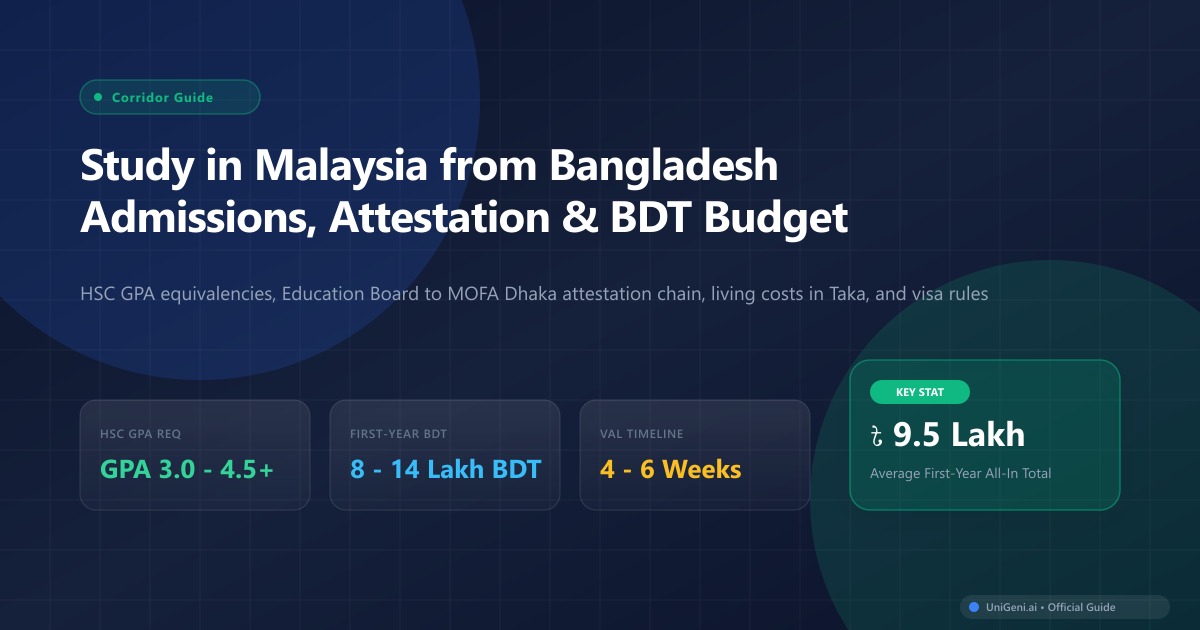
Study in Malaysia from Bangladesh: Admissions, Attestation and Budget
The Bangladesh-to-Malaysia route: HSC requirements, MOFA attestation, funds in BDT, EMGS timeline, flights and the Graduate Pass reality.
Studying in Malaysia from Bangladesh has moved from a niche choice to one of the fastest-growing corridors, and the numbers now prove it. EMGS data reported by Malaysian and Bangladeshi media shows 6,103 Bangladeshi students enrolled at Malaysian institutions in 2024, rising to 8,957 by November 2025, a jump of about 47 percent in a single year. Around 11,400 Bangladeshi students were studying there in total. Bangladesh now sits alongside China and Indonesia among Malaysia's largest source countries. The corridor works because the package fits: HSC-based entry, English-medium degrees, halal food, a four-hour flight from Dhaka, and costs far below Western destinations.
This guide plans the whole journey for Bangladeshi applicants and their families. It covers what your HSC results unlock, the attestation chain your documents must pass through in Dhaka, and how much money you need to show and to spend in taka. It then walks the application and EMGS timeline, flights and arrival. It also flags one honest limitation: Bangladesh is currently not on Malaysia's Graduate Pass list, so post-study plans need a different route. For shared mechanics, this page leans on the cost of studying in Malaysia 2026 breakdown and the Malaysia student visa EMGS guide, both linked in the sections below. The country overview lives on the study in Malaysia hub.
Why Bangladeshi students choose Malaysia
Three reasons come up in almost every counselling conversation. Cost is first: a private Malaysian bachelor degree typically costs a fraction of what the same UK or Australian branch degree costs at its home campus, and living costs in Kuala Lumpur sit well below Dubai or London. Second, instruction is in English, and Malaysian universities are used to South Asian applicants, with foundation, diploma and degree routes that fit HSC holders without A Levels. Third, the community already exists: tens of thousands of Bangladeshis live in the Klang Valley, Bangladeshi student associations operate at major universities, and halal food is the default rather than a search.
What your HSC unlocks
Malaysian universities accept the HSC and equivalent qualifications like Alim and Diploma-in-Business Studies for bachelor entry. Requirements sit in three broad bands, and they vary by institution, so treat these as market patterns rather than fixed rules.
- Direct bachelor entry at most private universities: typically a minimum HSC GPA around 2.5 to 3.0 out of 5.0, with SSC results also reviewed.
- Competitive universities and scholarship-tier entry: public universities like Universiti Malaya and top private institutions such as Sunway or APU commonly expect strong boards results, around GPA 4.5 and above, plus IELTS 5.5 to 6.5 or an accepted equivalent.
- Foundation or diploma routes: if your HSC GPA sits below direct-entry bars, a one-year foundation or a diploma plus degree articulation gets you to the same graduation point, often at lower first-year cost.
English proof has more options than IELTS alone. Many Malaysian universities accept MUET, PTE, TOEFL or their own placement tests, and our IELTS alternatives for Malaysian universities guide lists which route tends to work where. If your schooling was English-medium, some institutions accept a medium-of-instruction letter instead.
The attestation chain from Dhaka
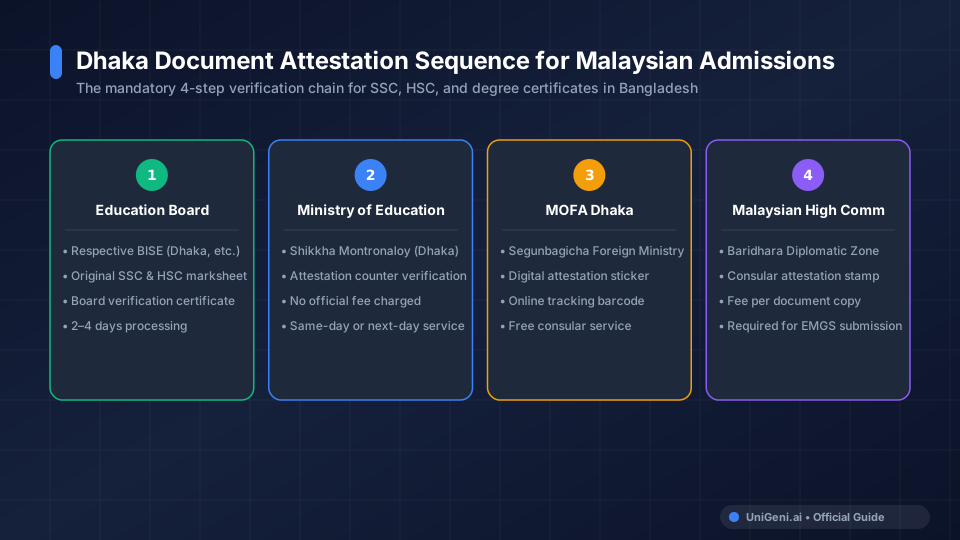
When a Malaysian university or EMGS asks for attested academic documents, the Bangladesh chain runs in a fixed order, and skipping a step sends you back to the start.
- Education Board verification. Your SSC and HSC certificates and marksheets go first to the issuing board (or via the board's online verification), which stamps them as genuine.
- Ministry of Education attestation. The board-verified documents are then attested by the Ministry of Education in Dhaka.
- MOFA attestation. The final stamp comes from the Ministry of Foreign Affairs, either at the counter in Dhaka or through the government's e-attestation and apostille portal.
Fees are modest per document but add up across certificates and marksheets; agent-quoted totals of a few thousand taka for the full chain are typical, though official fee schedules should be confirmed at each counter. One practical note: not every university asks for the full MOFA chain, and some accept certified true copies of your originals. Ask your university's international office for its exact document list before you spend weeks and taka on attestation you may not need. Our cross-country student documents checklist for Malaysia and the UAE shows how the pack fits together.
Proof of funds
There is no single official EMGS figure for how much money a Bangladeshi applicant must show. Universities and their immigration filings generally want bank statements covering the last three to six months, with a balance consistent with first-year tuition plus living costs, and a sponsorship letter if a parent or guardian is funding you. Agent guidance commonly cites around RM 50,000 for undergraduate and RM 60,000 for postgraduate as workable benchmarks including tuition and living costs, which at roughly BDT 30 per ringgit is about BDT 15 lakh and BDT 18 lakh respectively. Treat those as planning numbers, not rules: what matters is that the money is real, seasoned in the account, and matches the story your documents tell.
What the first year costs in taka
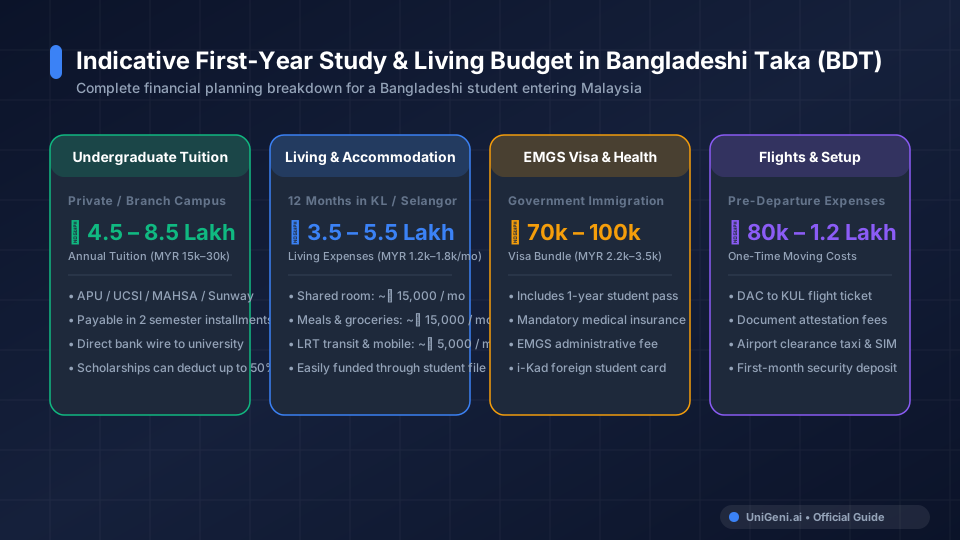
Converted at about BDT 30 to RM 1 (September 2026 rate), a realistic first-year budget looks like this. These are estimates built from the ringgit ranges in our cost guide, not quotations.
- Tuition and fees, private bachelor degree: roughly RM 20,000 to RM 45,000 for the year, about BDT 6 to 13.5 lakh, depending on university and programme.
- Living costs: roughly RM 1,200 to RM 2,000 a month, about BDT 36,000 to 60,000, covering a shared room, food, transport and phone.
- First-year EMGS and immigration charges: about RM 3,200 to RM 4,950, roughly BDT 1 to 1.5 lakh, including the refundable personal bond.
- Flights: BDT 35,000 to 55,000 return on the Dhaka-Kuala Lumpur route, cheapest booked about six weeks ahead.
Adding it up, most Bangladeshi students land at roughly BDT 13 to 20 lakh for the first year all-in, with later years cheaper because visa and arrival costs do not repeat at full weight. The cost of studying in Malaysia 2026 guide carries the city-by-city detail behind these bands.
Timeline, flights and arrival
Work backwards from your intake. Applications to private universities take one to three weeks to an offer. Once you accept and pay initial fees, the university opens your EMGS file, and the Student Pass process takes roughly eight to ten weeks to the visa approval letter in clean cases, longer in peak months. From Dhaka you then arrange travel: direct flights from Hazrat Shahjalal International to Kuala Lumpur take just under four hours, served by Biman Bangladesh Airlines, Malaysia Airlines, AirAsia and US-Bangla. Book after your approval letter lands, not before, and arrive in time for orientation and the post-arrival medical screening. The full sequence, fees and pitfalls are mapped in the Malaysia student visa EMGS guide.
Community life, work rules and the Graduate Pass reality
Life settles fast for most Bangladeshi students: senior students meet newcomers at the airport, student associations run orientation-adjacent events, and Bangla-speaking groceries and restaurants cluster around the main campuses. On part-time work, know the rule before you job-hunt: Malaysia permits international students to work at most 20 hours per week, only during breaks longer than seven consecutive days. Work is allowed only in sectors like restaurants, mini markets, petrol stations and hotels, and only with prior approval through your university. Our part-time work rules for international students guide lists the exact conditions. It is a supplement, not a funding plan.
The hard truth to plan around is the Graduate Pass. Malaysia's 12-month post-study pass for fresh graduates currently lists eligible nationalities, and Bangladesh is not on the list. EMGS reported in mid-2025 that Bangladesh's inclusion was agreed in principle, so check the current list before you plan around either outcome. Bangladeshi graduates who want to stay and work need an employer-sponsored Employment Pass arranged before the Student Pass expires, or they return home with a Malaysian degree, which carries solid value in Dhaka's job market. Either way, start that planning in your final year, not after convocation: the post-study work visa Malaysia guide explains the sponsored routes.
Corridor-relevant scholarships
Bangladeshi applicants compete for the same money as everyone else: merit bursaries and tuition reductions awarded on SSC and HSC grades, which is where strong boards results directly reduce fees, plus institution-specific awards at private universities. Grade-based waivers are typically reassessed each semester, so first-year results matter too. The full landscape, including how awards stack and what documents unlock them, is mapped in our scholarships in Malaysia for international students guide.
Frequently asked questions
Is HSC enough, or do I need A Levels?
HSC, Alim and equivalent qualifications are accepted for direct bachelor entry at most Malaysian universities, with GPA thresholds varying by institution. A Levels are not required, though strong results in either system help scholarship chances.
Can Bangladeshi graduates stay in Malaysia after graduating?
Not through the Graduate Pass, because Bangladesh is not currently on the eligible nationality list. Staying requires an employer-sponsored Employment Pass before your Student Pass ends, so begin job searches in your final year.
How much should our bank statement show?
There is no fixed official figure. Statements over three to six months covering first-year tuition plus living costs, commonly benchmarked around RM 50,000 for undergraduate study, are the practical standard, with a sponsorship letter if a parent funds you.
Which intake should I target after HSC results?
If your results and attestation are ready, the intake four to six months out is realistic. If documents need the full Dhaka chain, target the next-but-one intake and use the gap to strengthen English proof and scholarship applications.
If you want your HSC results, budget and intake plan reviewed against real programmes, talk to a counsellor and we will map the route from Dhaka to Kuala Lumpur together.