
Malaysia Student Visa (EMGS) Guide 2026: Steps, Fees and Timeline
How the EMGS Student Pass process works in 2026: step-by-step timeline, documents, MYR fee breakdown, and what happens after you land in Malaysia.
The Student Pass is the permit that lets you live and study in Malaysia as an international student, and EMGS is the agency that processes almost every application. If you hold an offer from a Malaysian university, you do not apply for this permit yourself at an embassy the way you might for other countries. Your university submits the application to Education Malaysia Global Services, known as EMGS, and the pass sticker is endorsed into your passport only after you arrive and clear a medical screening. From offer letter to arrival you should plan on roughly three months, because the official EMGS charter of 14 working days applies only to complete applications, and the stages around it, such as university checks, single entry visa issuance and travel booking, take longer.
The money side is fairly predictable. Official EMGS fee components for a programme longer than six months add up to about RM 1,600 in processing plus smaller charges for the approval letter, medical screening, insurance and the pass sticker, and Malaysian universities such as TAR UMT estimate total first-year EMGS and immigration charges at RM 3,200 to 4,950 including the refundable personal bond. This guide walks through the full sequence, the paperwork, the fees in ringgit, and the mistakes that delay or sink applications. For the wider picture of choosing Malaysia, start with the study in Malaysia hub, and for a general primer see our overview of student visa requirements for international students.
What EMGS actually is
Education Malaysia Global Services is the agency Malaysia's Ministry of Higher Education uses to administer international student enrolment. When people say "Malaysia student visa", they usually mean the Student Pass, and the Student Pass application runs through the EMGS platform at visa.educationmalaysia.gov.my. Two practical points follow from this setup.
First, your university is the applicant of record. You supply documents and pay fees, but the institution submits and liaises with EMGS, which is why choosing a university with a responsive international office matters. Second, you can track every application yourself on the EMGS portal using your passport number. Statuses move through processing stages shown in yellow and then green once approvals land, so you are never fully dependent on the university for updates.
The process from offer letter to arrival
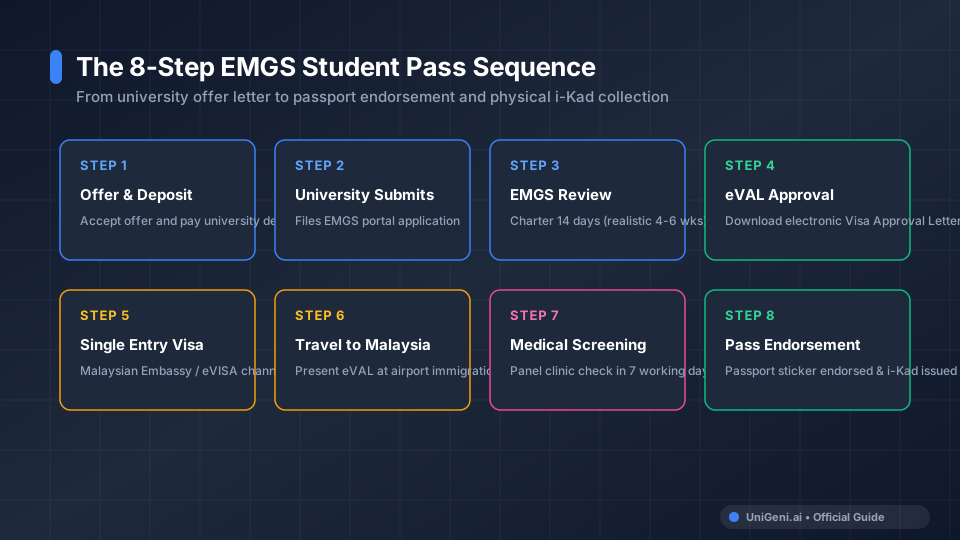
- Step 1: Offer letter. You apply to the university, receive an offer, and accept it by paying any deposit or first-semester fee the institution requires. Only then can the institution open your EMGS file.
- Step 2: University submits the EMGS application. You send your documents to the international office, which uploads them, pays or triggers the EMGS invoice, and submits the Student Pass application on your behalf.
- Step 3: Processing and the approval in principle. EMGS checks your documents and academic record, runs immigration checks, and, if satisfied, secures the approval in principle from the Immigration Department. The official client charter is 14 working days for a complete application, and incomplete files restart the clock, so document quality matters more than speed.
- Step 4: The eVAL. Once approved, EMGS issues the electronic Visa Approval Letter, called the eVAL. This document authorises you to obtain a visa and travel, and it is not the visa itself.
- Step 5: Single entry visa. If your nationality requires it, you apply for a Single Entry Visa to enter Malaysia. Pakistan is on EMGS's list of countries that need a Single Entry Visa before travel, so Pakistani students apply through the Malaysian High Commission in Islamabad or the consulate covering them, while some other nationalities, such as China and India, can use the faster online eVISA channel. The visa itself is cheap, around RM 20 for most countries, though visa agents and courier add-ons cost extra.
- Step 6: Fly to Malaysia. You enter on the single entry visa with your eVAL. Immigration records your arrival and gives you a temporary pass while post-arrival steps complete.
- Step 7: Medical screening. Within 7 working days of arrival you must complete a medical screening at an EMGS panel clinic. The standard panel clinic screening costs RM 250, though some universities let you do it at the campus clinic.
- Step 8: Student Pass endorsement and i-Kad. After you pass the medical, the Immigration Department endorses the Student Pass sticker in your passport and you receive the i-Kad, the identity card for non-citizens that you carry day to day. Your pass is then valid for the duration stated, typically tied to your programme with annual renewal.
One extra step applies to some students before travel. Certain countries, including Pakistan, are subject to pre-departure medical requirements, such as specific blood tests done at an EMGS-registered clinic in your home country, with the report completed in English. Your university will tell you if this applies to you, and you should verify current rules before your intake, since the country list changes.
What you will pay: official fee components
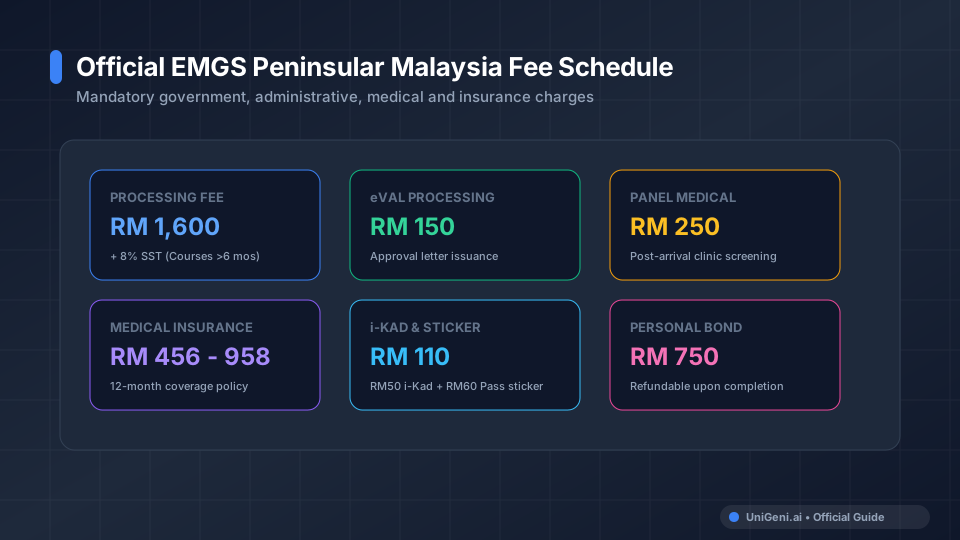
These figures come from the official EMGS schedule of fees for Peninsular Malaysia, retrieved September 2026. Verify current rules and use the EMGS fee calculator for your exact case, because categories differ slightly for polytechnics, language centres and East Malaysia.
- New student processing fee: RM 1,600 for programmes longer than six and up to twelve months, RM 800 for shorter ones
- eVAL processing fee: RM 150
- i-Kad processing fee: RM 50
- Medical screening at a panel clinic: RM 250
- Medical insurance: roughly RM 456 to 958 for twelve months depending on the plan
- Student Pass sticker fee: RM 60
- Multiple entry visa fee: RM 0 to 50 depending on nationality, RM 20 for most countries
- Courier charges: RM 10 where applicable
- Service tax of 8 percent applies on the processing and eVAL fees
- Personal bond: RM 750 for Pakistani and most South Asian nationals, held by the institution and refundable after you complete or leave the programme
Adding these up, first-year EMGS and immigration costs commonly land between RM 3,200 and 4,950 including the bond and insurance, which matches published university estimates. Students who exclude the bond often report paying RM 2,500 to 2,800. Treat any total below this band with suspicion, because cut-rate agents sometimes quote only the sticker fee and hide the rest.
Documents checklist
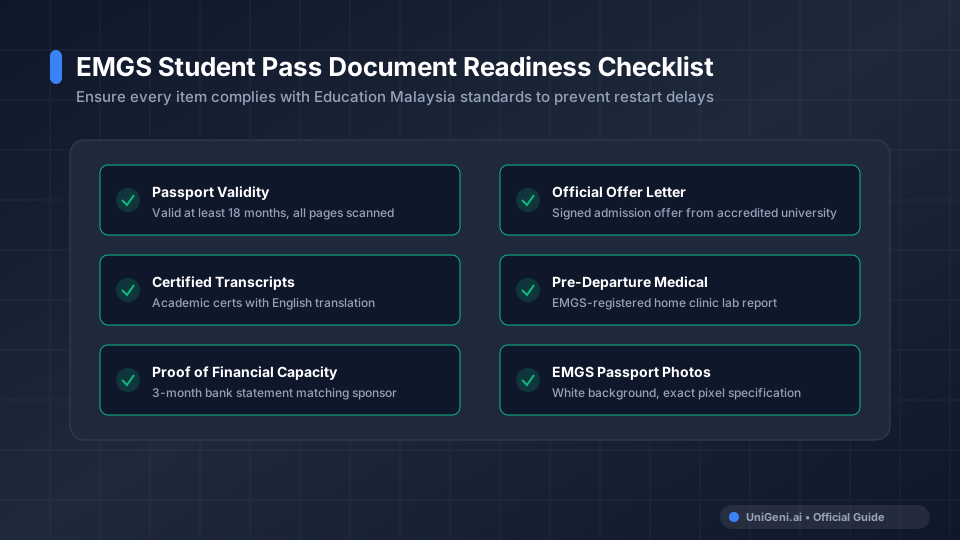
Exact lists vary by institution, but the core file looks like this.
- Passport with clearly readable data page and sufficient remaining validity; keep a scanned copy
- Offer letter from the institution
- Academic certificates and transcripts, with certified translations if not in English
- Pre-departure medical report from an EMGS-registered overseas clinic where your country requires it, completed in English
- Proof of financial capacity, commonly bank statements for recent months
- Sponsorship letter if a parent or guardian is funding you, with their identification
- Passport-sized photographs meeting the EMGS photo specification
- Any university-specific forms, such as health declaration or accommodation confirmation
How long each stage really takes
The 14 working day charter is the clean case. In practice, universities advise that the full journey from accepting an offer to landing in Malaysia can stretch to three months, and the most common pattern reported by students is four to six weeks from submission to eVAL, followed by one to two weeks for the single entry visa, plus flight time. Peak intake months of August to October and February to March slow everything down. Work backwards from your programme start date and aim to have your complete document file with the university at least three months before you need to be on campus.
Why applications get delayed or rejected
- Incomplete, inconsistent or poorly scanned documents, which is the single biggest cause of delay because EMGS returns the file and processing restarts
- Financial proof that does not match stated sponsors or looks insufficient for tuition plus living costs
- Failed medical screening, either pre-departure or the post-arrival panel check
- Academic record problems, such as results that cannot be verified or grades below the institution's floor
- Errors in the passport details that do not match the offer letter
If an application is rejected, ask the university for the stated reason, because appeals through EMGS are possible and rejection before approval generally triggers a refund of unspent fees. A rejected application also does not bar a fresh one, but you should fix the underlying cause first.
How Unigeni counselors handle this alongside your application
Because the university submits the EMGS file, the visa is really an extension of the admission process, and that is how Unigeni treats it. Your counselor checks documents before they ever reach the university, flags the attestation and translation issues that commonly stall files from Pakistan and other South Asian countries, tracks the EMGS status with you at each stage, and sequences the single entry visa and travel booking so you do not overstay the eVAL window. Pakistani applicants can read the full corridor walkthrough, including IBCC and HEC attestation, in our study in Malaysia from Pakistan guide.
The process rewards early, careful preparation and punishes last-minute assembly. If you want that handled alongside your university application, create a free account on Unigeni and a counselor will map both timelines together for your intake.
Sources
- EMGS portal (https://visa.educationmalaysia.gov.my) — Student Pass process, tracking and Single Entry Visa country list.
- EMGS schedule of fees v1.6 (https://visa.educationmalaysia.gov.my/media/cms_upload/Schedule_fees_-_v1.6.pdf) — official fee components from processing to i-Kad.
- EMGS medical screening guideline (https://visa.educationmalaysia.gov.my/guidelines/medical-screening) — panel clinic screening within 7 working days of arrival.
- Education Malaysia (https://educationmalaysia.gov.my) — 14 working day client charter and eVISA channel.
- TAR UMT (https://tarc.edu.my) — first-year EMGS and immigration total of RM3,200 to RM4,950.
- IDP Pakistan (https://idp.com) — Pakistani student total visa cost context.