
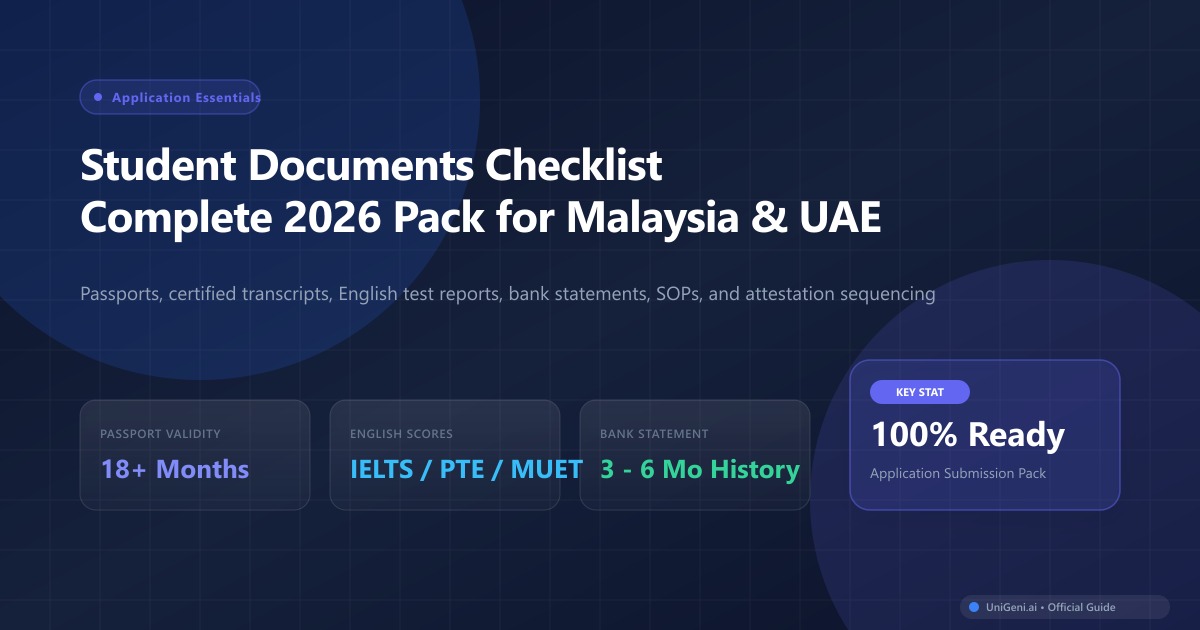
Student Documents Checklist for Malaysia and UAE Applications
The full document pack for Malaysia or UAE applications: passports, transcripts, English proof, funds, SOPs, references and a stage-by-stage checklist.
This student documents checklist covers the complete pack of papers a university admissions office and a visa authority will ask for between shortlisting and arrival; for Malaysia and the UAE it runs to roughly 12 to 18 items assembled over four to six months. Three rules shape the whole pack. Your passport needs at least 18 months of remaining validity for a Malaysian Student Pass application, but six months suffices for UAE entry. Your financial proof needs a consistent three-month bank history rather than a sudden deposit. And every document must show exactly the same name, spelled the same way, or files stall. Get the pack right and both processes, which are university-driven in both countries, move quickly; get it wrong and you lose weeks at the worst possible time.
Work through each document family in turn, watch the country differences flagged along the way, and finish with the master checklist organised by application stage plus the mistakes that delay the most files. It covers both of our destinations, so start from the study in Malaysia or study in UAE hubs if you have not chosen yet; country-specific attestation chains are owned by our corridor guides and linked below.
Identity documents
Your passport is the backbone of the pack. For Malaysia, EMGS and the Immigration Department expect a passport valid for at least 18 months when your Student Pass application is filed, because the pass is issued for up to 12 months and renewed annually. For the UAE, the standard requirement is six months of validity beyond your date of travel, and your university's visa office will want a copy with at least one blank page for the residence visa. If your passport expires inside those windows, renew before applying, because renewing mid-process forces every document to be reissued against the new number.
Scan your national identity card if your country issues one, and keep birth certificates handy: universities and visa offices use them to verify name and date of birth when documents disagree.
Academic documents
Collect formal transcripts and completion certificates for everything after secondary school you want recognised: Higher Secondary certificates and Intermediate mark sheets, O and A Level statements of result, diploma or degree transcripts, or your bachelor's degree and transcript for master's applications. Three standards apply. Documents must be official, meaning issued or certified by the board or university, not notarised photocopies. If you apply before final results, most private universities in both countries accept predicted results for a conditional offer, with the final certificate required before enrolment or visa filing. And if your qualification comes from a different system, expect an equivalence step: Pakistani applicants with O and A Levels need an IBCC equivalence certificate before Malaysian universities can map them to local entry standards.
English proof
Most programmes taught in English want evidence of proficiency, but IELTS is not the only route, and choosing the wrong test wastes money you could spend on application fees. Malaysian universities accept a range of alternatives, including MUET, PTE and TOEFL, English-medium study declarations and internal placement tests at some institutions, and our IELTS alternatives for Malaysian universities guide lists which route works where. UAE universities typically set their own IELTS or TOEFL floors per programme, and some run internal assessments. Check the programme page before booking any test, because requirements differ not only between universities but between faculties.
Financial proof
Both countries want evidence you can pay for tuition and living costs, but neither publishes one universal figure, so treat the format as the fixed part and the amount as university-specific. The format: recent bank statements, usually covering about three months, in your name or your sponsor's, with a sponsorship letter and a copy of the sponsor's identification if a parent or guardian is funding you. For Malaysia, guidance commonly cited by universities points to USD 7,000 to 10,000 as a comfortable figure, though this is not a published EMGS minimum and each institution sets its own expectation. For the UAE, guides cite balances of AED 30,000 to 50,000 over three to six months as a common benchmark. Two rules matter more than the number: the sponsor named in your application must match the account holder, and sudden large deposits invite questions that consistent balances never do.
Statement of purpose and essays
A statement of purpose is a one to two page essay explaining why this programme, this university and this country fit your goals. Malaysian private universities often make it optional or brief; UAE universities, particularly branch campuses, increasingly ask for it, and scholarship panels at both destinations treat it as decisive. Write specifically: name the programme content you want, connect your background to it, and state a realistic career goal. Avoid commissioned essays, because inconsistencies between your SOP and transcripts are a known rejection trigger.
Recommendation letters
Ask for one to two letters from teachers, lecturers or supervisors who can compare you to peers, because specific comparison, such as top five of sixty students, outweighs generic praise. Give recommenders your transcript, SOP draft and deadline, and ask early: a month of lead time is the difference between a considered letter and a template. Some universities accept signed letters on letterhead; others route references through an online form, so brief your referees to expect an email link.
Photographs and file formats
Photographs are a small item that sinks files. For Malaysia, EMGS specifies passport-style photographs against its published photo specification, and your university states size and background when you apply. For the UAE, universities ask for recent photographs on a white background for the entry permit and Emirates ID. Beyond photos, set one scanning standard for the pack: colour, 300 dpi where possible, one clearly named file per document, because low-resolution scans are the most common reason EMGS returns a file.
Translations and attestation: the overview
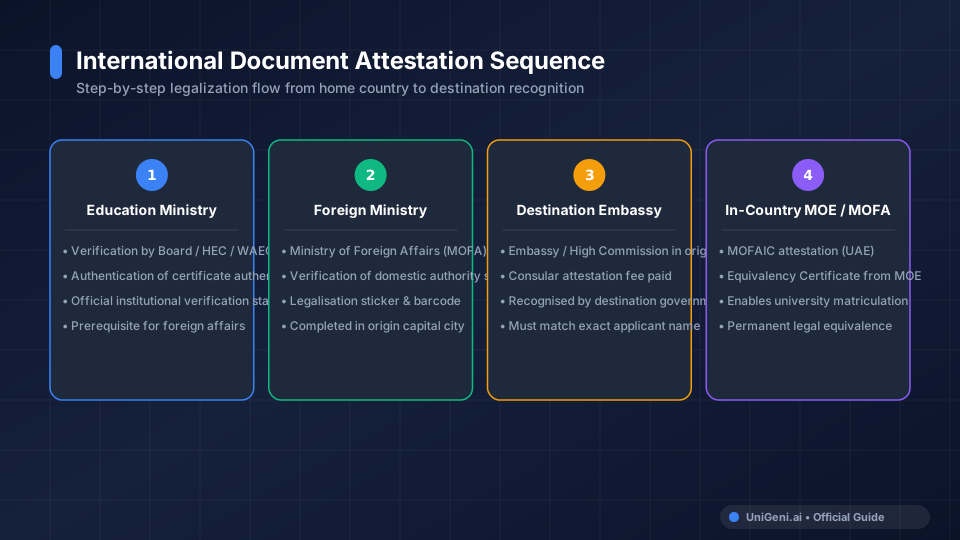
Any document not in English needs a certified translation, and the translator's declaration must accompany it. Attestation, meaning official verification of your certificates through your home country's authorities, works as a chain: the education body first, then the foreign ministry, then the destination embassy where required. What trips applicants up is doing the chain in the wrong order or paying for the full chain when the university only needs certified copies at the admission stage. The exact chain depends on your nationality, so our corridor guides own that detail: the study in Malaysia from Pakistan guide walks the IBCC, HEC and MOFA sequence Pakistani applicants actually use, and equivalent guides for other corridors are listed on the country hubs.
The master checklist by stage
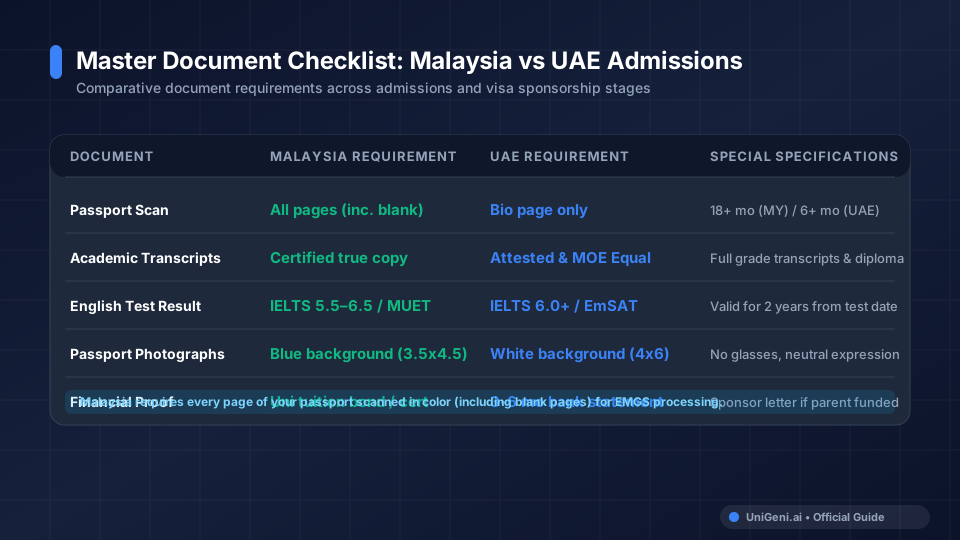
- Shortlisting and application: passport scan with required validity; academic transcripts and certificates or predicted results; English proof or a booked test date; SOP where required; recommendation letters; application fee payment.
- Offer and visa filing: accepted offer letter and deposit receipt; certified or attested academic copies as the university specifies; financial proof in the sponsor's matching name; medical forms including any pre-departure tests required for your nationality; passport photographs to specification.
- Pre-departure: visa approval letter printed (eVAL for Malaysia, entry permit for the UAE); original certificates in hand luggage; flight booking aligned to intake; cash for first weeks; digital copies of the full pack in cloud storage.
- Arrival: passport with blank pages; offer and accommodation letters; insurance documents; funds for the first month, since bank accounts open only after your visa or pass is endorsed.
Common mistakes
The files that stall share the same flaws:
- Names spelled differently across passport, transcripts and application forms
- Scans too poor to read
- Bank statements that name a different sponsor than the application
- Attestation started in the wrong order or too late
- Passports with too little validity for the destination
- Photographs in the wrong format
Every one of these is avoidable in an afternoon of checking, four to six months before your intake.
Frequently asked questions
Do all my documents need attestation before applying?
Usually not. Most universities in both countries assess applications on certified copies and ask for attested or original documents later, at enrolment or visa stage. The full home-country chain matters when the university or an embassy specifically requires it, so confirm the requirement before paying for attestation you may not need yet.
How long should my passport be valid?
Malaysia needs at least 18 months of validity at Student Pass application, while the UAE needs six months beyond travel, though a passport covering your full first year avoids mid-process renewals in both countries. If you are under those thresholds, renew before applying.
Can I apply before my final results are out?
Yes. Predicted results and provisional certificates support conditional offers at most private universities in Malaysia and the UAE, with final documents required before enrolment or visa filing. Apply early, but tell your school referee to keep predicted grades realistic, because large gaps create verification problems.
How much money should the bank statement show?
There is no single published figure. Universities commonly look for consistency over three months rather than a fixed amount. Guidance cited for Malaysia points to USD 7,000 to 10,000, and UAE guides cite AED 30,000 to 50,000. Your institution sets the actual expectation, and the sponsor must match the account holder.
The cheapest way to find out what your specific universities will ask for is to have the pack reviewed before you pay anything. Create a free account on Unigeni, upload what you have, and a counsellor will check it against each university's requirements.
Sources
- EMGS portal (https://visa.educationmalaysia.gov.my) — passport validity, photo specification and Student Pass document standards.
- Malaysia Immigration Department (https://www.imi.gov.my) — passport validity of at least 18 months for student applications.
- Emirates visa information (https://www.emirates.com) — six months passport validity for UAE travel.
- ICP (https://icp.gov.ae) — UAE residence visa and Emirates ID requirements.
- HEC e-portal (https://eportal.hec.gov.pk) — degree attestation chain example for the Pakistan corridor.
- MOFA Pakistan apostille services (https://apostille.mofa.gov.pk) — foreign ministry stage of the attestation chain.