

Staying and Working in Malaysia After Graduation: 2026 Guide
What actually exists in 2026: the 12-month Graduate Pass and its nationality limits, the tougher Employment Pass salary rules, and the DE Rantau option.
Post-study work rights in Malaysia are the options that let you stay in the country after your Student Pass ends, and in 2026 they come in three shapes: the Graduate Pass, a 12-month stay for eligible graduates; the Employment Pass, an employer-sponsored work permit whose salary floors rose sharply on 1 June 2026; and the DE Rantau pass for digital nomads with foreign income. There is no automatic right to remain after graduation. Your Student Pass expires with your programme, and anything you do next is a separate application with its own conditions. This guide sets out what each route requires, what it costs, and what is realistic for a fresh graduate, including the detail many summaries skip: the Graduate Pass is limited to a specific list of nationalities, and as of September 2026 Pakistan is not on it. Verify current rules before you plan around any of this, because Malaysian work-pass policy has changed repeatedly in the past two years.
The headline numbers to hold onto: the Graduate Pass buys 12 months for eligible passport holders with a RM 900 processing fee; the Employment Pass now requires a basic salary of at least RM 5,000 per month at the entry category, double the old RM 3,000 floor, while fresh-graduate salaries in Kuala Lumpur commonly sit between RM 2,800 and RM 5,000; and DE Rantau needs USD 24,000 per year of foreign income for tech professionals. If you are still choosing a programme, the study in Malaysia hub covers the front end of the journey, and the EMGS Student Pass guide covers the visa that gets you there.
What happens when your Student Pass ends
When you complete your programme, your institution cancels your Student Pass, typically within weeks of results or ceremony, and you are expected to leave unless another pass is approved before then. This is the part graduates underestimate. There is no grace period you can casually work through, and there is no conversion of a Student Pass into a work pass. Every route below is a fresh application, some of which must be filed while your Student Pass is still valid. Timing, in other words, is half the strategy.
The Graduate Pass: 12 months, but check your nationality
The Graduate Pass is a Social Visit Pass introduced for international graduates of Malaysian institutions. It gives an additional 12 months in Malaysia without needing an employer sponsor, allows part-time work in permitted job sectors, comes with a multiple entry visa, and lets eligible dependants extend their passes for the same period. The official processing fee is RM 900, with dependants at RM 250, plus a year of medical insurance.
The conditions are where it gets exacting. You must hold a valid Student Pass at the time of application, meaning you cannot apply after your pass lapses or from a social visit pass. You need a passport valid for at least 18 months, a completion letter from your institution, health insurance for the full year, a personal bond stamped by the Inland Revenue Board, no convictions in Malaysia, and, unusually, a Malaysian citizen sponsor earning at least RM 1,500 per month who documents their income with payslips and bank statements.
The decisive filter is nationality. EMGS lists 33 eligible countries for the Graduate Pass. China and India are included case-by-case until 31 December 2026, requiring a letter of good conduct. Pakistan, Bangladesh, and most African countries are not on the current list, so graduates from those countries cannot rely on this route as of September 2026. The list has been expanded before and may change again, so verify current rules on the EMGS Graduate Pass page rather than relying on older articles, and treat any marketing that promises a universal 12-month post-study work permit as inaccurate for now.
The Employment Pass route after June 2026
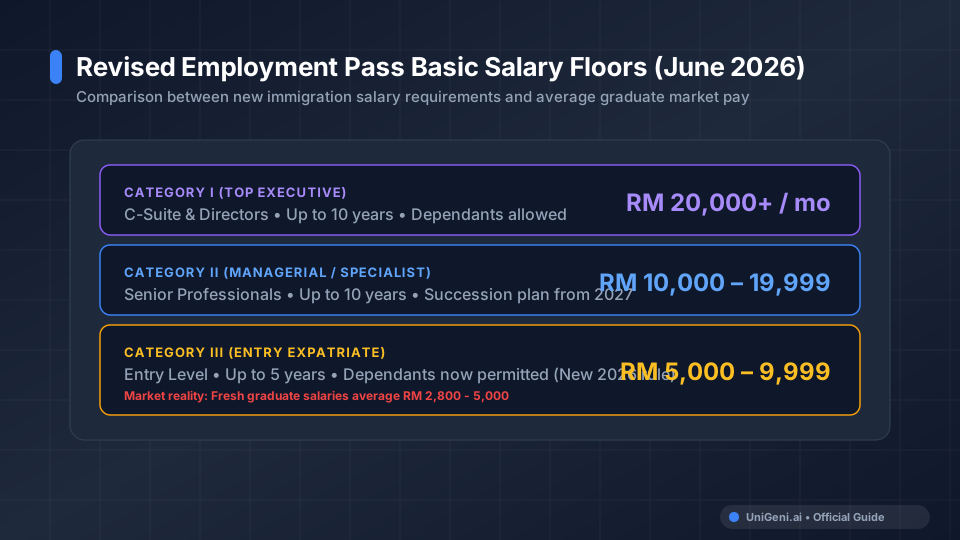
The Employment Pass is the standard full-time work permit, sponsored by a Malaysian employer and processed through the Expatriate Services Division. On 1 June 2026 the Revised Expatriate Salary Policy roughly doubled the minimum basic salary in every category, based on basic salary only with allowances excluded.
- Category I: minimum RM 20,000 per month, up to 10 years, dependants allowed
- Category II: RM 10,000 to 19,999 per month, up to 10 years with a succession plan required for applications from 1 January 2027, dependants allowed
- Category III: RM 5,000 to 9,999 per month, up to 5 years with a succession plan from 2027, dependants now allowed, which was not possible before
Three further changes matter to graduates. Minimum-salary exemptions for Category III, which employers once used to hire fresh foreign graduates below the floor, are no longer accepted. Renewals filed on or after 1 June 2026 must meet the new minimums, so older passes do not grandfather forever. And the employer must be registered with the ESD and justify the hire, with supporting approvals through the expatriate gateway, which means the practical question is never just whether you are good enough, but whether the role pays enough and the company is set up to sponsor.
This is why the arithmetic is sobering for a fresh graduate. Market estimates place typical entry-level salaries for graduates in Kuala Lumpur around RM 2,800 to 5,000 per month, and the new Category III floor is RM 5,000. Sponsorship is still achievable in sectors that pay early-career expatriates well, such as engineering, data, fintech and oil and gas, but the comfortable assumption that any decent offer converts into a pass no longer holds. Salary figures are market estimates rather than official statistics, so verify current rules and gauge roles individually.
DE Rantau: the digital nomad option
DE Rantau, run by MDEC, is the route that most articles written before 2024 get wrong in your favour: it is open to all nationalities except Israel, explicitly including Pakistanis, and it is the one post-study option with no employer sponsorship and no Malaysian income at all.
The pass is issued as a Professional Visit Pass for 3 to 12 months, renewable once for a further 12, with a maximum stay of 24 months. To qualify you need annual income of at least USD 24,000 from non-Malaysian sources as an IT or digital professional, or USD 60,000 for the listed non-tech roles such as finance, marketing and management positions. You must be over 18, hold a passport with more than 14 months of validity, apply online through the MDEC portal, and wait 6 to 8 weeks for processing. Note the edges: the pass covers residence in Peninsular Malaysia and Labuan rather than Sabah and Sarawak, your spouse cannot work on a dependant DE Rantau pass, and a tourist pass cannot convert into it, so an in-country application requires exiting and re-entering after approval where a visa with reference applies to your nationality.
For a graduate who already freelances for clients in Pakistan, the Gulf or anywhere outside Malaysia, this can be the most realistic way to stay, provided the income floor is genuinely met.
Realistic paths for a fresh graduate

- Line up sponsorship before your Student Pass ends. Interview in your final semester, target ESD-registered employers, and aim for an offer at or above the Category III floor so the Employment Pass application can be filed while you are still in status.
- Use the Graduate Pass if your nationality allows. For eligible passport holders it is a low-pressure year of job hunting with part-time work rights, and the RM 900 fee is modest for 12 months of runway.
- Build foreign freelance income and apply for DE Rantau. This works from inside Malaysia on a valid pass or from Pakistan, since you do not need to be in the country to apply.
- Progress to further study. A master's through the same institution is a progression application in EMGS rather than a fresh file, buying two more years in the system and a later, stronger shot at the job market.
- Leave and return with a pass in hand. Many graduates return home and re-enter once an employer has secured an Employment Pass approval, which is slower but keeps your record clean, and a clean record matters for every future Malaysian application.
Common misconceptions
- That everyone gets a 12-month stay after graduation. Only the eligible-nationality list does, and it is not automatic even for them; it is an application with a sponsor, a bond and insurance requirements.
- That the Graduate Pass is a work permit. It permits part-time work in permitted sectors while you look for a proper sponsor, not full-time employment.
- That any job offer equals a visa. Since June 2026 the salary floor decides category eligibility before anything else, and exemptions are gone.
- That you can sort it out after arrival on a visit pass. Conversion from a social visit or tourist status into work passes is not permitted under the rules these routes use.
Plan the exit before you need it. If you are weighing programmes with an eye on staying to work afterwards, pick a field where Malaysian employers sponsor at the new salary levels, and build the filing calendar backwards from your final semester. You can map that timeline with a counselor by creating a free account on Unigeni.
Sources
- EMGS Graduate Pass page (https://visa.educationmalaysia.gov.my) — pass terms and the 33-country eligibility list.
- EMGS schedule of fees v1.6 (https://visa.educationmalaysia.gov.my/media/cms_upload/Schedule_fees_-_v1.6.pdf) — Graduate Pass fees of RM900 main applicant and RM250 dependant.
- Revised Expatriate Salary Policy booklet (https://esd.imi.gov.my/portal/pdf/Revised_Expatriate_Salary_Policy.pdf) — Employment Pass category salary floors.
- Revised Expatriate Salary Policy FAQ (https://esd.imi.gov.my) — 1 June 2026 effective date and renewal mechanics.
- DE Rantau Pass FAQ v10.0 (https://mdec.my/api/media/file/DE-Rantau_Pass_FAQ_v10.pdf) — income floors, 24-month maximum stay and eligibility rules.
- EMGS Hub (https://hub.emgs.com.my) — cross-check that Bangladesh is ineligible for the Graduate Pass.