
Scholarships in Malaysia for International Students: The 2026 Map
Every scholarship type open to international students in Malaysia: merit tiers, government postgraduate awards, agent waivers and how renewals work.
Scholarships in Malaysia for international students almost always arrive as a percentage discount on tuition rather than cash paid to you: an award is anything that reduces what you pay the university. The scale is the headline. Published tier systems at Malaysian universities run from 5 percent for modest results up to 100 percent of tuition for top performers. Government scholarships exist, but only at postgraduate level, and most awards must be re-earned every year through your cohort ranking or CGPA. There is no single national fund for international undergraduates. The money sits inside universities, inside two postgraduate government schemes, and inside a small number of platform-linked waivers.
Before shortlisting any university, know five things: how merit tiers actually work, with published examples; which government schemes exist and who they are for; how foundation-to-degree progression awards work; what platform-linked waivers look like, including an exclusive opportunity for Pakistani applicants; and how renewal conditions should shape which offer you accept. For awards open right now with live deadlines, our scholarships listing carries the current rows, and for the wider destination picture start with the study in Malaysia hub.
The four places scholarship money sits
University merit awards are percentage discounts on tuition set by your school results, and they fund most international undergraduates. Government schemes are real but narrow: the Malaysia International Scholarship and the MTCP Scholarship are both postgraduate-only. Progression awards reward students who continue from a university's own foundation into its degrees. Platform and agent waivers are reductions tied to specific application channels, the least standardised type, so confirm them in writing. Each is covered in turn.
University merit awards: how the tier systems work
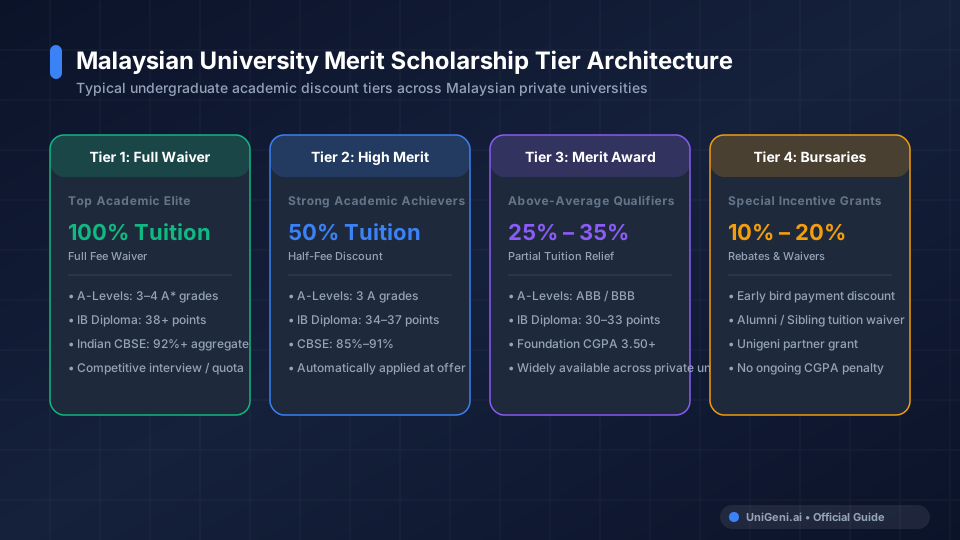
The most transparent published example is Xiamen University Malaysia, the English-medium branch campus of a top Chinese university in Sepang. Its merit scholarship counts Grade A results, meaning A+, A or A minus, in qualifications such as SPM, O-Level, UEC, STPM and A-Level. Undergraduate entrants with UEC, STPM or A-Level results earn a 25 percent tuition waiver with one Grade A, 50 percent with two, 75 percent with three and 100 percent with four. Foundation entrants assessed on SPM or O-Level results climb from 5 percent with one Grade A to 100 percent with ten. These tiers are published on the university's 2026 scholarship schedule, whose other pre-university tables are scoped to Malaysian applicants, so confirm your qualification maps before counting Grade As. The catch for applicants from Pakistan and similar systems is that qualification mapping differs: your Intermediate or local board results are assessed on their own scale, so ask admissions how your certificate converts before you estimate a tier.
A second is UCSI University in Kuala Lumpur, whose Trust Scholarship for international students is a partial tuition fee waiver sustained across undergraduate study. Published entry bars include AAA at A-Levels, a CGPA of at least 3.80 from a UCSI foundation or diploma, an IB total of 36 or an ATAR of 90, with a selection interview for shortlisted candidates. Its Trust Graduate Scholarship offers full or partial waivers for master's and doctoral study, requiring at least an upper second class honours degree or a CGPA of 3.50 on the master's route.
A third is INTI International University, whose International Education Scholarship applies to first-year tuition for qualifying students, with terms published each intake.
Two boundaries matter as much as the examples. First, some headline scholarships are not open to direct international applicants: Taylor's University states that its undergraduate scholarships are limited to Malaysian students and international students progressing from within its education group, though its postgraduate scholarships are open to internationals. Second, small waivers circulate in listings you should verify: MMU listings mention a 10 percent waiver for self-funded international students without a merit award, but that figure comes from third-party listings rather than the university's own page, so confirm it with the institution.
The mechanics repeat across the sector. Awards are percentages of tuition only, never registration fees, visa charges or living costs; they apply for the standard programme duration, with repeated semesters usually at full cost; and you generally cannot stack them with grants: Xiamen University Malaysia awards either the merit scholarship or a study grant, whichever is higher.
Government schemes: postgraduate only
The Malaysia International Scholarship, run by the Ministry of Higher Education, funds full-time Master's and PhD study by citizens of its recipient countries at Malaysian public universities, covering tuition and allowances with exact benefits set in each cycle's official guidelines. Applications for 2026/2027 closed in mid-2026, so plan for the next annual window. The MTCP Scholarship, run by the Ministry of Foreign Affairs, funds Master's degrees of 24 to 36 months for students from developing countries, covering tuition fees and other allowances.
The honest summary for undergraduates: there is no national government scholarship open to international bachelor's students in Malaysia. A first-degree search is therefore a university-level search, which is why the merit tiers above deserve most of your attention. For a Master's or PhD, both schemes are worth an application alongside university awards, and public universities are where the government money can be spent.
Foundation-to-degree progression awards
Progression awards are discounts universities give their own foundation students when they move into a degree, often the most reliable money in the system because the university already knows your results. The pattern repeats across institutions: Xiamen University Malaysia lists a Progression Scholarship for its own foundation students, though its published terms apply to Malaysian applicants; Taylor's extends undergraduate scholarships to internationals progressing within its education group; and UCSI's trust publishes separate pre-university awards for recent IGCSE cohorts.
Ask about progression terms before enrolling in any foundation programme. If the foundation carries a strong progression award, a slightly higher first-year fee can become the cheaper route over four years; if it does not, a cheaper foundation elsewhere costs you nothing later.
Tuition waivers through platforms and agents
Some tuition reductions are attached to the channel you apply through rather than only to your grades. Platforms and agents sometimes carry exclusive waiver arrangements with universities, and these are legitimate money, but vague promises also circulate in this category, so insist on written university confirmation before paying any application or deposit fee. One real example from our platform: Unigeni offers an exclusive tuition-waiver opportunity at Xiamen University Malaysia for eligible Pakistani applicants, and you can check which tier your results could reach on the Xiamen exclusive scholarship page. It is a platform opportunity assessed case by case against the university's published criteria, not a separate university programme, and the final award is confirmed by the admissions office.
Renewal conditions: the part that decides your real saving

Malaysian scholarships are rarely four-year guarantees. Xiamen University Malaysia requires undergraduates holding 80 to 100 percent waivers to finish each year in the top 25 percent of their cohort, with progressively lower ranking requirements for smaller waivers. UCSI's international Trust Scholarship requires a minimum CGPA of 2.50 to keep a partial award, with full awards holding a higher bar.
Read those rules as risk. A 100 percent award with a top-25-percent condition is worth less than face value if your programme grades harshly. Three questions to ask before accepting any award: what exactly must I achieve each year, what happens to my fees if I slip, and does the condition reset or compound.
A stacking strategy that works
Scholarship strategy in Malaysia is mostly course-choice strategy. Compare net fees, not waivers: a 30 percent discount on an RM39,600-a-year degree still costs more than a full fee at an RM20,000 university, and our top 10 affordable universities in Malaysia 2026 list gives you the fee levels to run that arithmetic. Then pair the discount with city costs, because a tuition waiver in Kuala Lumpur can be eaten by rent that would be a third lower in Kuching or Penang. Finally, weigh renewal risk against programme difficulty: the safest financial plan is often a mid-tier waiver at a university where you can comfortably hold the required CGPA, rather than a top-tier waiver you might lose in year two.
Frequently asked questions
Can international students get a 100 percent scholarship in Malaysia?
Yes, at the top of published merit systems. Xiamen University Malaysia awards 100 percent tuition waivers to undergraduate entrants with four Grade A results in UEC, STPM or A-Level qualifications, and UCSI's trust publishes full waivers for exceptional candidates. These awards renew only if you meet the cohort ranking or CGPA conditions each year.
Are there Malaysian government scholarships for international students?
Only at postgraduate level. The Malaysia International Scholarship funds Master's and PhD study at public universities, and the MTCP Scholarship funds 24 to 36 month Master's degrees for students from developing countries. International bachelor's applicants are limited to university merit awards and platform-linked waivers.
Do Malaysian scholarships cover living costs?
Almost never at undergraduate level. University merit awards are tuition discounts, and rent, food, visa charges and insurance remain yours to fund. The government postgraduate schemes include allowances on top of tuition, which is one reason they are competitive.
What happens if my grades drop after the first year?
Your award typically drops or lapses with it. A scholarship requiring top-25-percent cohort ranking pays nothing in a year you finish below that line, and you then pay full tuition. Check whether the university downgrades you to a smaller tier or removes the award entirely before you accept the offer.
Building a shortlist around the awards you can realistically win and hold is exactly the kind of planning a counsellor does daily. If you want your grades mapped against published tiers across our partner universities, talk to a counsellor for free.
Sources
- Xiamen University Malaysia scholarships and financial aid (https://www.xmu.edu.my/admissions/scholarships-financial-aid) — Grade A tier waivers, grant exclusivity and cohort ranking renewals.
- UCSI University Trust (https://www.ucsiuniversitytrust.com/scholarship) — international Trust Scholarship criteria, graduate awards and CGPA renewal terms.
- Ministry of Higher Education, Malaysia International Scholarship (https://biasiswa.mohe.gov.my) — postgraduate government scheme and cycle status.
- MTCP Scholarship, Ministry of Foreign Affairs (https://mtcp.kln.gov.my) — Master's awards of 24 to 36 months covering tuition and allowances.
- INTI International University (https://newinti.edu.my) — International Education Scholarship applying to first-year tuition.
- Taylor's University (https://university.taylors.edu.my) — undergraduate scholarship eligibility limited to Malaysian and progression international students.