

Part-Time Work in Malaysia for International Students: The Real Rules
The exact part-time work rules in Malaysia: the 7-day-break limit, approved sectors, realistic pay rates, taxes, EPF and what breaks your Student Pass.
International students in Malaysia are allowed to work part-time, but the permission is narrower than most blog posts claim. The official rule allows a maximum of 20 hours per week, only during semester breaks or holidays longer than seven consecutive days. It applies only in four sectors, and only after your university and the immigration authorities approve the job. Working during term time, even under 20 hours, is not part of the permission. Pay sits at or slightly above the legal floor. The national minimum wage, RM 1,700 per month since 1 February 2025, works out to roughly RM 8 to RM 9 per hour.
This page explains the work rights attached to a Malaysian Student Pass for students from Pakistan, Bangladesh, Nigeria, the wider MENA region and everywhere else. It covers the rule precisely, which sectors and job types are open or banned, and how the approval process works. It also covers what you can expect to earn, the tax and EPF basics, and how working outside the rules can end your studies. It does not cover staying to work after graduation, which is a different permission entirely; the post-study work visa Malaysia guide, linked later in this article, covers that. For how the Student Pass itself works, see the Malaysia student visa EMGS guide, and for the wider destination picture, the study in Malaysia hub.
The exact rule, without the myths
The most common myth is "you can work 20 hours a week anytime". That is not what the official guidance says. According to the EMGS Hub FAQ on part-time work, international students may work part-time under all of the following conditions at once.
- You hold a valid Student Pass.
- You work only during semester breaks or holidays of more than 7 consecutive days.
- You work no more than 20 hours per week.
- The job is in an approved sector: mini markets, restaurants, petrol stations or hotels.
- Your employer and job are cleared through your institution and the state immigration office before you start.
Note what is missing: there is no general permission for term-time work, no exception for online freelancing, and no blanket right to work on campus without the same approval chain. If a recruiter tells you otherwise, the risk lands on your pass, not theirs.
Where you can and cannot work
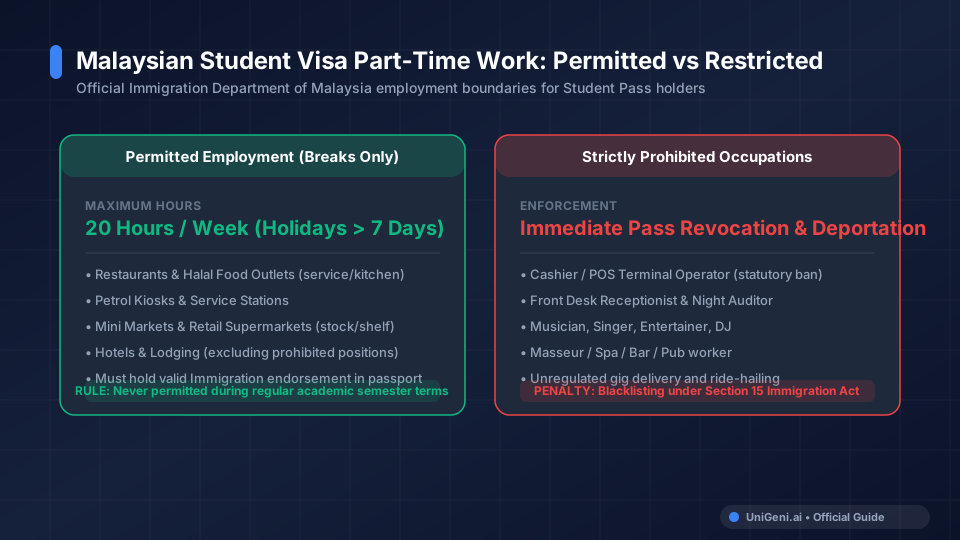
The four approved sectors cover the classic student jobs. These span shelf stocking and counter help at mini markets, kitchen and service roles at restaurants, forecourt and shop work at petrol stations, and behind-the-scenes or service roles at hotels. Within these sectors there are still prohibited roles. The immigration guidance explicitly bars students from working as cashiers, and from jobs as singers, masseurs or anything categorised as morally undesirable. This in practice closes entertainment outlets and spa-type venues regardless of how the job is advertised.
On-campus vacancies, such as library assistants, lab helpers or event crews hired by the university itself, are popular precisely because the employer understands the approval process. You still route them through your international office rather than shaking hands and starting the same day. Freelance work for overseas clients over the internet is a grey zone that the Student Pass rules do not clearly permit. Treat it as not allowed rather than not regulated, and get any paid activity checked by your international office first.
How to get permission
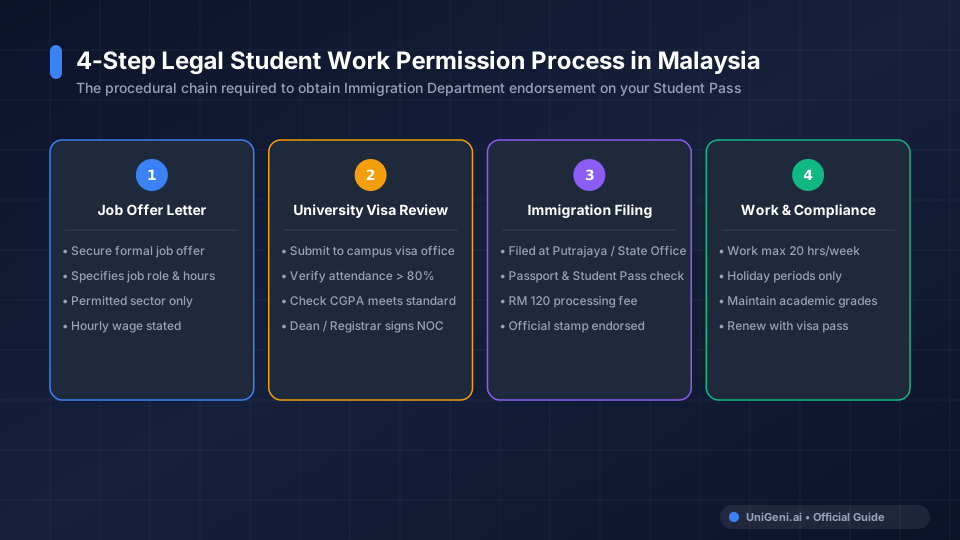
The process runs through your university, not through a job platform. In outline: you find an eligible employer, the employer issues an offer and provides its business registration details, your international office checks the role against the sector and role limits, and the office submits the part-time work request to the Immigration Department for endorsement. Only when the endorsement lands may you start work.
Two practical consequences follow. First, employers who have hired international students before will move fast, while employers who have not will often give up halfway, so target businesses near campus that already employ students. Second, your working window is by definition temporary, tied to the break, so plan earnings as a supplement to your budget, never as a pillar of it. Families budgeting the full cost should work from the cost of studying in Malaysia 2026 numbers rather than projected wages.
What the pay looks like
The floor is law. Malaysia's minimum wage rose to RM 1,700 per month from 1 February 2025 for employers with five or more employees, which converts to an hourly floor of roughly RM 8.18 to RM 8.72 depending on the working-week structure, and part-timers are entitled to it pro-rated by the hour. Market rates for student roles mostly sit a little above the floor.
- Restaurant and mini market crew: commonly RM 8 to RM 12 per hour.
- Weekend and event shifts in Kuala Lumpur: advertised at RM 15 to RM 18 per hour.
- A full break-period month at 20 hours per week: roughly RM 700 to RM 1,400 depending on rate and weeks worked.
Those are gross figures. At 20 hours per week you are earning supplemental money, roughly RM 700 to RM 1,000 in a typical month, which covers food and transport rather than tuition.
Tax and EPF basics
Two systems touch your payslip, and both have changed recently.
EPF. From 1 October 2025, EPF contributions became mandatory for non-Malaysian employees at 2 percent from the employer and 2 percent from the employee, replacing the older arrangement where foreign-worker contributions were largely optional. The government has since announced a reassessment of that 2 percent policy, so confirm the current rate with your employer when you sign. The contributions are not lost money: they accumulate in your EPF account and can be withdrawn when you leave Malaysia permanently.
Income tax. Whether you are a tax resident depends on days spent in Malaysia. Cross roughly 182 days in a year and you are taxed on progressive rates with personal reliefs, which usually means break-period wages owe nothing. If you are a non-resident, as many first-year students are before they pass 182 days, Malaysian employment income is taxed at a flat 30 percent with no reliefs. The law contains no exemption for student wages, so do not treat "students do not pay tax" as fact; keep payslips and check with LHDN if you earn across several breaks.
How violations endanger your Student Pass
Your Student Pass is a privilege tied to conditions, and work is one of the clearest conditions. Working without endorsement, working during term, exceeding 20 hours, taking a banned role such as cashier, or working for an employer who never registered you are all breaches of pass conditions. Consequences escalate from pass cancellation to removal from Malaysia, and a work-related violation on your record follows you into every future Malaysian pass application, including the Employment Pass an employer might later sponsor you for.
The pattern to avoid is the friendly cafe that says paperwork is unnecessary and pays cash. If there is no endorsement, there is no record, and when immigration inspectors come, you are the person working illegally, whatever the boss said. Use the international office, keep copies of your endorsement and contract, and decline any role that starts before approval lands. After graduation the picture changes completely, and the post-study work visa Malaysia guide covers which pass you need to stay legally.
Frequently asked questions
Can I work during the semester if I stay under 20 hours?
No. The official permission applies only during semester breaks or holidays of more than 7 consecutive days. Term-time work at any hourly count breaches your pass conditions.
Can I work as a cashier at a petrol station?
No. Petrol stations are an approved sector, but cashier roles are specifically excluded from student part-time work, across all sectors.
Do I need to file a tax return on my part-time income?
Usually not, if you are a tax resident: cross roughly 182 days in Malaysia in a year and progressive rates plus reliefs typically zero out break-period earnings. If you are a non-resident, as many first-year students are, employment income is taxed at a flat 30 percent with no reliefs. There is no student exemption in law, so keep payslips and confirm with LHDN if you earn in several breaks or above modest totals.
Can I do online freelance work for clients abroad?
The Student Pass rules do not clearly permit it, and it is safer to treat it as not allowed. Ask your international office before taking any paid online engagement.
If you want your study budget stress-tested without counting on part-time wages, talk to a counsellor about scholarships and realistic funding for your programme.
Sources
Figures checked September 2026.
- EMGS Hub (https://hub.emgs.com.my) — official FAQ on part-time work: 20 hour weekly cap, breaks of more than 7 days, approved sectors and prohibited roles.
- Ministry of Human Resources Malaysia (https://www.mohr.gov.my) — minimum wage order raising the floor to RM 1,700 from 1 February 2025.
- KWSP (https://www.kwsp.gov.my) — mandatory 2 percent employer and 2 percent employee EPF contributions for non-Malaysian employees from 1 October 2025.
- Inland Revenue Board of Malaysia (https://www.hasil.gov.my) — non-resident tax treatment at a flat 30 percent without reliefs.
- ASEAN Briefing (https://www.aseanbriefing.com) — hourly conversion of the RM 1,700 minimum wage.
- Troopers (https://troopers.com.my) — market hourly rates for student part-time roles.