
UAE University Intakes and Deadlines Guide 2026
Plan UAE application timing: September, January and summer intakes, rolling admissions at private universities, visa buffers and a back-planned timeline.
UAE university intakes are the entry windows during which a degree programme starts: a main Fall intake in September, a secondary Spring intake in January, and short summer sessions that run between May and July. Around those windows sit the things that trip applicants up. Many private universities review applications on a rolling basis rather than at one hard cutoff. International files need attested documents. And the student visa only starts after your admission and deposit, adding roughly two to five weeks before you are a legal resident.
Working backwards from your target start month is the whole task. This guide covers how the three intakes differ, which universities run which calendars, how rolling admissions really behave, the lead times that matter, the visa buffer and the dorm-booking squeeze. It finishes with a back-planned timeline you can copy. Dates were checked in September 2026; intakes shift by a week or two year to year, so treat every date here as a planning anchor and confirm on the university's admissions page. For the broader destination picture, see our study in the UAE hub.
The three intake windows
Fall: September, the main intake
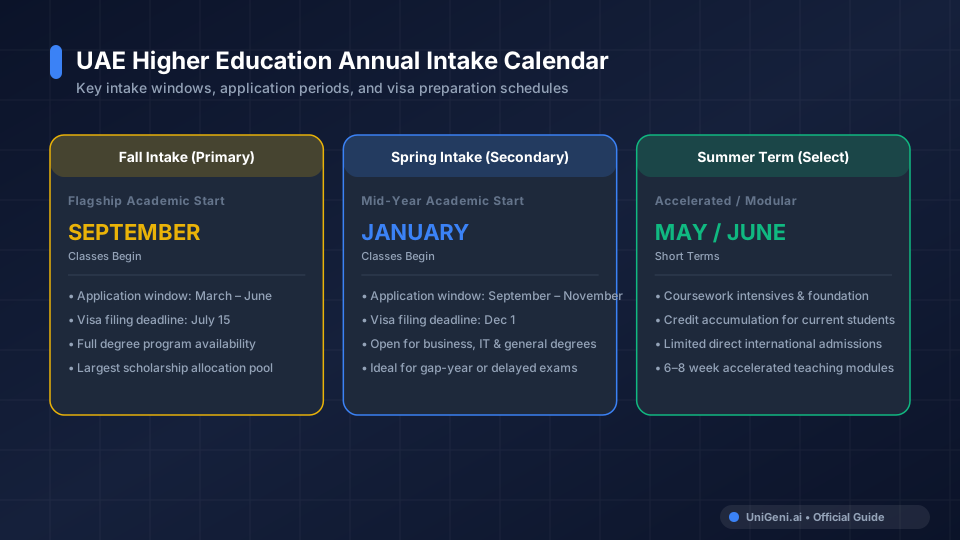
September is when the UAE academic year begins, and it is the only intake where every university, every programme and every scholarship cycle is fully open. Heriot-Watt University Dubai's calendar is typical: welcome week runs in the second week of September (7 to 11 September for the coming cycle) and teaching runs to early December. Orientation events, club recruitment and on-campus job onboarding all happen now, so September starters integrate fastest. If you have a choice, aim here.
Spring: January, the second chance
The January intake is smaller but widely available. Heriot-Watt Dubai runs a full second semester with welcome week in the second week of January and teaching from 18 January, and most private universities in Dubai and Sharjah admit in January as well. Programme choice is narrower, some scholarship rounds are closed, but for students who missed September for visa, financial or results reasons, spring is a clean restart with no academic penalty.
Summer: May to July, the patch intake
Summer is not a full intake at most universities. It exists as short, intensive sessions for current students catching up or accelerating, plus a few foundation and English programmes that start mid-year. The universities with genuine late-spring starts are worth knowing: UOWD under its trimester system and Heriot-Watt's May semester, though both mainly serve current students. UOWD starts its third trimester in late April and also runs an optional summer school. A genuinely new start in late spring is possible there when it is not elsewhere.
Which universities run which calendar
Two calendars dominate. Semester-system universities, like Heriot-Watt University Dubai, treat September and January as their main entry points; Heriot-Watt also runs a compact May semester, mainly for continuing students, so check whether your programme admits new students into it. Trimester-system universities, like the University of Wollongong in Dubai, run three full intakes: September, January and April-May, plus optional summer. Amity University Dubai treats September as its main intake and opens a spring round with its own application window and deadline listed on Amity's apply page for the current cycle.
Federal universities are stricter. United Arab Emirates University runs a single main undergraduate cycle for September, and its application portal has shown fall undergraduate deadlines in early August, with education consultants commonly advising international applicants to file by mid-June because document verification from abroad takes longer. The safe rule for federal institutions: treat their published deadline as the outer edge, not the target.
How rolling admissions actually work
Many private universities evaluate applications as complete files arrive and issue decisions within two to six weeks. This is genuinely more flexible than a single cutoff, and aggregator platforms have shown September intakes at UAE universities still accepting applications as late as the end of that month. But rolling has a catch that catches families: rolling means first-come, first-served, not unlimited. Scholarship money, dorms and popular programmes fill months before the technical closing date, and visa processing eats the tail. A rolling admission in late August can leave you holding an offer you cannot use because the visa will not finish in time.
Practical targets: file by March to April for September if you want scholarships and housing choices, by May to June for a plain September admission, and by September to October of the previous year for the most competitive January files.
Lead times international applicants need
- Attested documents. Transcripts and certificates often need attestation from your home country's education ministry and foreign ministry plus UAE Embassy legalisation, then possibly UAE Ministry of Foreign Affairs stamping on arrival. This chain alone can take three to six weeks.
- English tests. IELTS or equivalent needs a test date, results in two to five days, then sending scores to universities. Book before you apply, not after.
- Conditional offers. If you await final results, apply with forecasts and convert later, but the visa still cannot start until conditions clear.
Our student documents checklist for Malaysia and the UAE lists exactly what to attest and in what order.
The visa buffer
This is the deadline families underestimate most. Your university sponsors the student residence visa, and the file opens only after admission is confirmed and the deposit is paid. Standard processing runs about two weeks for approvals, and most students hold the stamped visa and Emirates ID within two to five weeks of arriving in the UAE, because the medical fitness test and ID biometrics happen after entry. Two consequences for your calendar: do not book flights before the university confirms your entry permit, and do not plan to start earning, renting privately or opening bank accounts in your first days. The full sequence, fees and failure points are in our UAE student visa guide for 2026, which owns that process end to end.
Dorm booking timing
Housing is the quiet hard deadline. University residences are allocated first-come, first-served once you pay the housing deposit, and Dubai's purpose-built student blocks publish their rates and open bookings for the following September during the preceding spring, with popular room types selling out. If you want the safety of a residence in September, commit by May or June. If you plan to rent privately instead, plan to arrive one to two weeks early for viewings, and budget for the deposits involved; the realistic rent and deposit numbers are in our cost of studying in the UAE 2026 guide.
A back-planned timeline for September
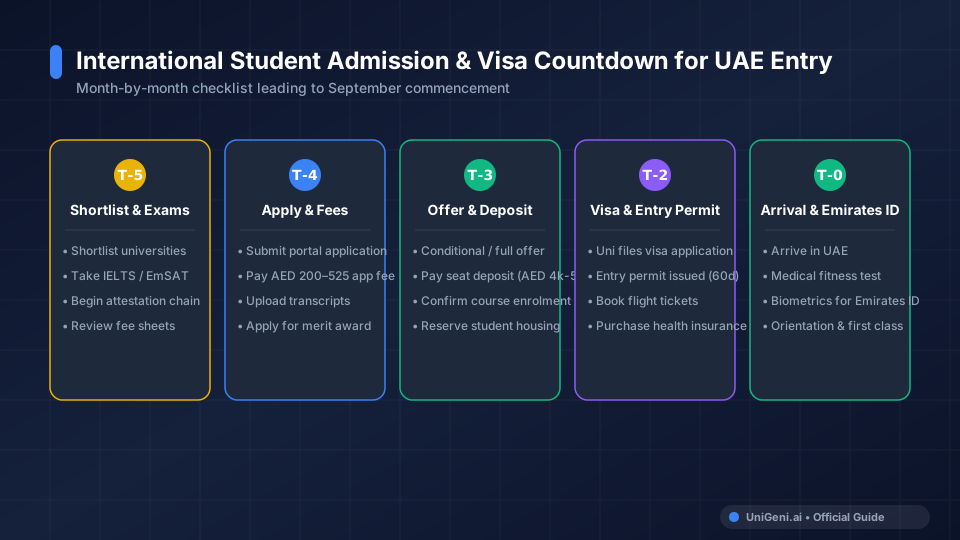
- Ten to eight months out (November to January): shortlist universities by programme and fee tier, book English tests, start attestation.
- Seven to five months (February to April): submit applications, chase transcripts, apply for scholarships where deadlines cluster in spring.
- Four to three months (May to June): accept the best offer, pay the seat and tuition deposit, open the visa file, reserve housing.
- Two months (July): entry permit issued, book flights for one to two weeks before orientation, arrange first-week funds.
- One month to arrival (August): complete pre-arrival forms, plan the medical test for week one, attend orientation.
For the January intake, shift the same sequence earlier: applications by early autumn, deposits by October, visa files by November. For the application mechanics themselves, our how to apply to universities in the UAE guide walks each step.
Frequently asked questions
Is the January intake looked down on by employers?
No. The degree certificate is identical and graduation simply shifts by one semester. The real differences are narrower programme choice and fewer scholarship seats, not credibility.
When is it genuinely too late for September?
When the remaining time cannot cover the visa. If you are accepting an offer less than about six weeks before orientation from outside the UAE, ask the university directly whether visa processing can finish in time, or whether they will defer you to January. Rolling admission does not speed up ICP or GDRFA processing.
Do universities charge application fees for each intake?
Usually yes, and they are non-refundable, commonly a few hundred dirhams per application. If you miss an intake and reapply for the next, expect to pay again unless the university explicitly carries your file forward.
Can I defer an offer to the next intake?
Most private universities allow one deferral, often by a semester to a year, sometimes with a fee and re-issuance of the offer at the new fee level. Get the deferral and the fee year in writing, because a fee increase between intakes is common.
Does applying early improve scholarship chances?
At most universities, yes, because scholarship pools are limited and awarded as strong files arrive. Several Dubai campuses also run early-bird tuition discounts for early payment, so early offers can carry direct financial value. Verify each scholarship's own deadline on its page rather than assuming the admission deadline covers it.
If mapping your own timeline against specific universities feels risky, you can create a free account on Unigeni and have a counsellor check your dates, documents and visa buffer against this year's actual intake calendar.
Sources
- Heriot-Watt University Dubai (https://www.hw.ac.uk/dubai/study/apply/academic-calendar) — semester dates including September and January welcome weeks, 18 January teaching start and the May semester.
- University of Wollongong in Dubai (https://www.uowdubai.ac.ae/teaching/new-trimester-system) — trimester structure with September, January and April intakes plus optional summer school.
- Amity University Dubai (https://amityuniversity.ae/join-amity/apply-now) — September main intake and spring application window.
- United Arab Emirates University (https://www.uaeu.ac.ae) — undergraduate admission cycles and fall deadlines.
- Global Admissions (https://www.globaladmissions.com) — UAE programmes still accepting September 2026 applications late in the cycle.
- Mastersportal (https://www.mastersportal.com) — recommended four to six month application lead times for international students.