
UAE Student Visa Guide 2026: Steps, Fees and Renewals
How the UAE student visa works in 2026: university sponsorship, ICP steps, documents, costs from about AED 3,000, renewals and part-time work rules.
A UAE student visa is a residence permit that lets you live in the country for the length of your program, and in almost every case it is sponsored and filed by your university rather than by you. Universities accredited in the UAE take legal responsibility for their international students: the visa office submits the application to the Federal Authority for Identity, Citizenship, Customs and Port Security (ICP), or through Dubai's residency authority GDRFA for many Dubai campuses, and the permit is normally issued for one year and renewed annually while you remain enrolled.
The numbers worth knowing up front: total out-of-pocket costs for the visa process commonly land between AED 3,000 and 8,500, covering the entry permit, medical fitness test, Emirates ID and health insurance, with some Dubai universities charging closer to AED 8,000 to 10,000 once their own service fees are added. Standard processing takes around two weeks, and most students hold the finished residence visa and Emirates ID within two to five weeks of arriving in the UAE. This guide walks through the whole sequence so you know what your university will ask for, what it will cost, and where the process can stall.
How the university-as-sponsor model works
Unlike destinations where you apply for a study permit directly to an immigration authority, the UAE routes student residence visas through the institution. Your university must be licensed and accredited, and it acts as your sponsor for the duration of your studies. In practice you never face ICP or GDRFA alone for the initial application: you send documents to the university's visa office, pay the fees it invoices, and it files the application, tracks approvals and arranges your entry permit.
This model has two practical consequences. First, the visa process starts only after your admission is confirmed and, at most universities, after you have paid a tuition deposit, so a late deposit means a late visa. Second, the visa is tied to that university. If you withdraw or transfer to another institution, the sponsorship ends and the visa must be cancelled and re-issued under the new sponsor.
Dubai versus the other emirates
Dubai-based universities generally file through GDRFA, often via Amer service centres, while campuses in Abu Dhabi, Sharjah, Ras Al Khaimah and the northern emirates file through ICP. From your side the steps are almost identical. The differences show up in small fee variations and in which authority's name appears on receipts and approvals. The university's visa office chooses the channel, so its instructions are the ones to follow. If you are still comparing destinations and campuses, start with our study in the UAE overview.
The process step by step
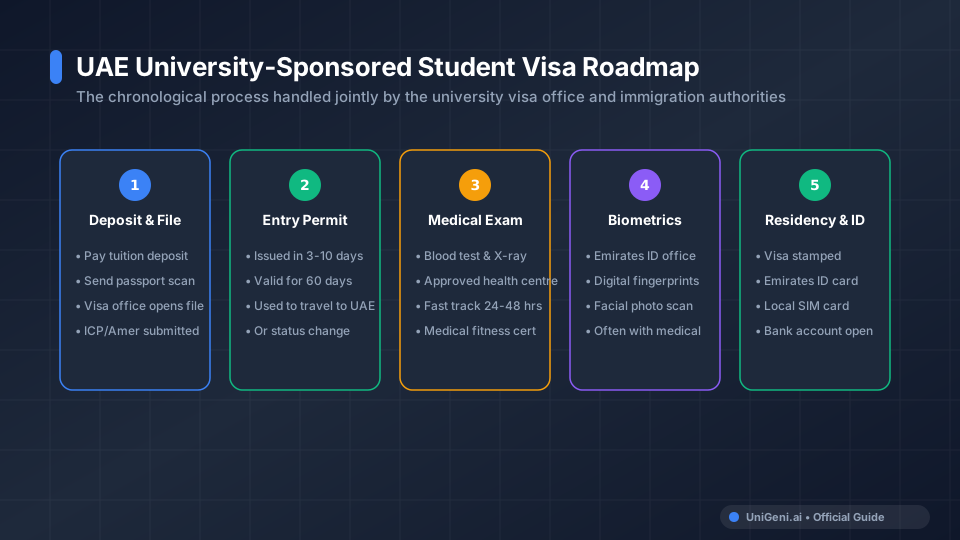
Admission and deposit
You accept your offer and pay the tuition deposit the university requires. Visa files usually open at this point. Deposits vary by institution, and third-party guides commonly cite figures in the range of AED 5,000 to 15,000 with an official receipt; your offer letter states the exact amount.
Entry permit
The university applies for a study entry permit on your behalf and sends you a copy. You use this document to travel to the UAE. If you are from a country with visa-on-arrival access, you may instead enter directly and the university will convert your status inside the country.
Status change on arrival
If you entered on a visit visa or visa-free, the university arranges a change of status so your file converts to a residence application without you having to exit the UAE. This is routine and handled by the visa office.
Medical fitness test
Within days of arrival you complete a medical fitness examination, typically a blood test and chest X-ray, at an approved centre. Booking and payment are done online, and at many centres your Emirates ID biometrics (fingerprints and photograph) are captured during the same appointment, so arrive early and follow the prep instructions, for example removing henna or contact lenses where required.
Emirates ID and visa issuance
After the medical result clears, the residence visa is issued and your Emirates ID card goes into production. Students commonly report receiving the ID application form within days of the medical exam and the physical card two to four weeks after visa stamping is complete. Once the visa is issued you can open bank accounts, get a local SIM in your own name and complete housing paperwork.
Documents to prepare
The exact list is set by your university's visa office, but these items appear on almost every checklist:
- Passport copy valid for at least six months, with blank pages
- Recent passport photograph on a white background
- Official admission or enrolment letter from the university
- Receipt of tuition deposit or fee payment, with VAT receipt where issued
- Proof of accommodation in the UAE, such as a hostel or dormitory booking, where the university requires it
- Bank statements or sponsor letters where financial proof is requested; third-party guides cite balances of AED 30,000 to 50,000 held over three to six months as a common benchmark
- Health insurance valid in the UAE, often purchasable through the university
Scan everything in colour before you travel and keep the originals accessible in your hand luggage, not checked baggage.
Fees and typical timelines
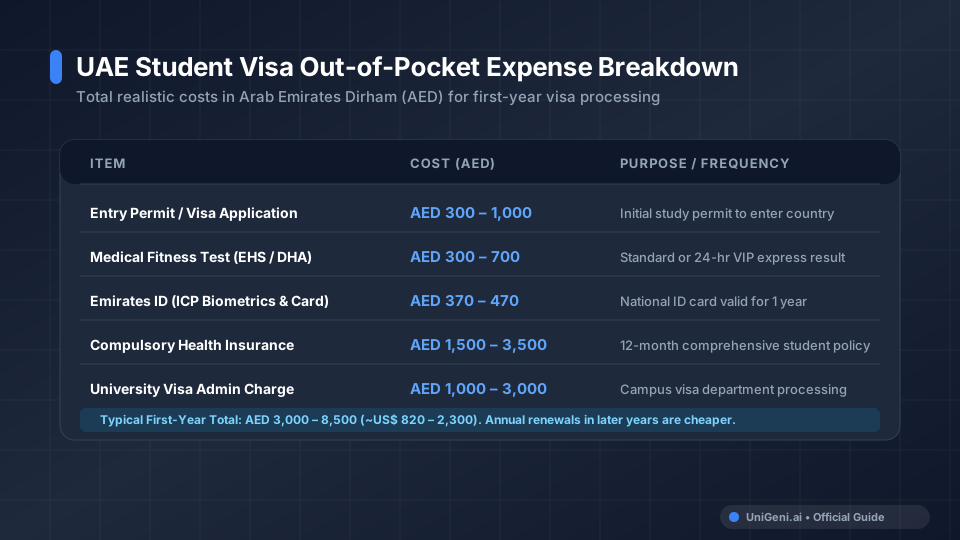
The ICP lists an application fee of about AED 100 for the residence file, with the rest of your total made up of the entry permit, status change if needed, the medical test, Emirates ID, insurance and university service charges. That is why realistic totals sit between AED 3,000 and 8,500 for most students, and higher at some Dubai institutions. Standard processing runs roughly 14 working days, with express options of 7 to 10 days at some universities, and the Emirates ID follows two to four weeks after stamping. Fees change periodically, so treat your university's invoice as the authoritative figure.
Renewals, program changes and travel
Student residence visas are renewed annually through the university, usually starting around 30 days before expiry. Renewal needs proof of continued enrolment, and some universities require an updated medical or insurance policy. Plan renewals around summer travel, because an expired visa cannot be renewed from outside the country without extra steps.
If you change your major within the same university, the visa usually continues as it is. Transferring to a different university is a different matter: the first sponsorship is cancelled and the new institution re-issues the visa, so time the transfer with both visa offices to avoid a status gap.
For travel, a residence visa allows multiple entries. Be careful with long stays outside the UAE: guides commonly cite a 180-day absence rule after which the residence may be considered cancelled. If a family emergency might keep you abroad for months, tell your visa office before you leave.
Part-time work as a student
Working on a student visa is legal only with the right permit. The federal framework provides a student training and employment permit through the Ministry of Human Resources and Emiratisation (MOHRE), which allows registered establishments to employ students aged 15 and above who are already in the UAE. In practice three things are needed: valid student residence, a no-objection process involving your university, and an employer registered with MOHRE who obtains the permit.
Guides for international students commonly describe a cap of around 20 hours of part-time work per week during term, with fuller hours possible during official breaks, subject to the permit conditions. Wage levels for student roles are typically modest. Because hour caps and enforcement details are set by MOHRE policy and can change, verify the current conditions with your university's international office before accepting any job. Working without a permit puts your visa at risk, and that risk lands on you, not the employer.
Dependents
Student visa holders generally cannot sponsor dependents. If your spouse or parents are moving with you, they need their own basis for residence: a parent who is a UAE resident can sponsor dependent children under the standard age and marital-status rules, and a working spouse can sponsor you instead of the university in eligible cases. Rules differ between emirates and change periodically, so confirm current criteria with ICP or your counsellor before planning family relocation.
Keep the sequence in mind
None of the individual steps is difficult, but each one depends on the previous one: admission letter, then deposit, then entry permit, then medical and Emirates ID, then the stamped visa. The most common delays come from incomplete documents, unpaid deposits and missed medical appointments in the first week. Prepare the document list early, respond to the visa office quickly, and budget the full AED 3,000 to 8,500 rather than just the headline application fee. For a wider look at documentation standards across destinations, see our guide to student visa requirements for international students. If you want help choosing a UAE university and managing the application end to end, you can create a free account on Unigeni and work with a counsellor from there.
Sources
- ICP (https://icp.gov.ae) — residence application fee of about AED 100.
- MoHRE (https://mohre.gov.ae) — student training and employment permit from age 15.
- UAE federal portal (https://u.ae) — work permit framework and the GDRFA/ICP channel split.
- Emirates Health Services (https://ehs.gov.ae) — medical fitness test process and booking.
- GDRFA (https://gdrfad.gov.ae) — Dubai residence visa channel for Dubai campuses.
- NYU Abu Dhabi (https://nyu.edu) — biometrics captured at the medical appointment.