

How to Apply to Universities in the UAE: 2026 Step-by-Step
A step-by-step UAE application walkthrough: shortlisting, documents, direct versus platform routes, fees, offers, deposits and the visa handover.
Applying to a university in the UAE means applying to each institution directly. The country has no central application system like UCAS in the UK: you fill in each university's own application, pay its application fee, and receive a decision from that institution. The cycle is short by international standards. Decisions on complete files commonly arrive within two to six weeks, and application fees typically run AED 100 to 300 per university. The whole sequence, from shortlisting to a deposited offer, fits inside two to three months when documents are ready. This guide covers exactly how to apply to universities in the UAE for 2026 entry, step by step, so you can execute the process, not just understand it.
The walkthrough assumes you have already narrowed your interest to the UAE generally; the case for the destination, including the campus landscape across Dubai, Sharjah and Abu Dhabi, is in our study in the UAE overview.
Step 1: Shortlist by curriculum match and budget
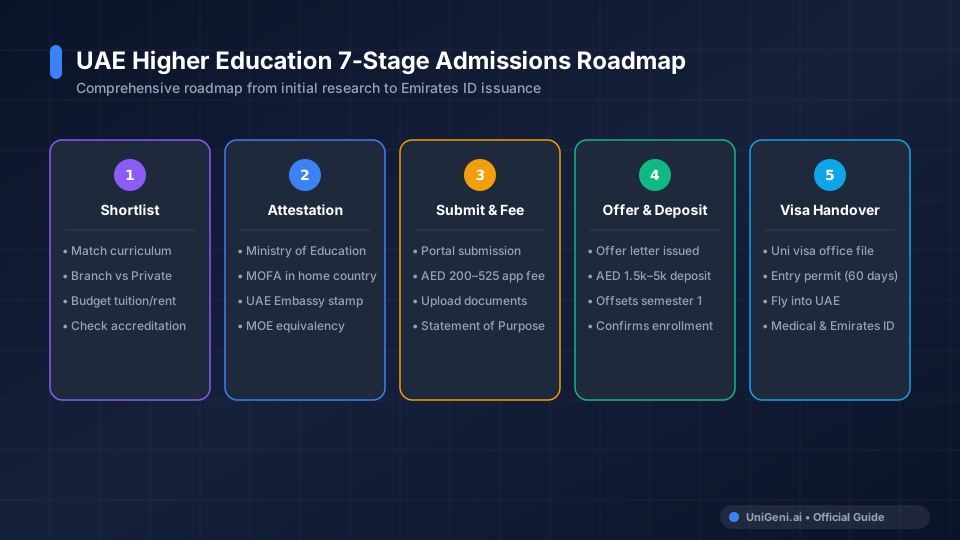
Build a list of four to six programmes before you touch an application form. Two filters do most of the work.
- Curriculum match. UAE universities publish country-specific equivalence tables, so check how your qualification, whether Pakistani Intermediate, Indian boards, A Levels or a national diploma, maps onto each programme's entry bar. Two universities can price similar ambitions very differently in grades, so the entry table is as important as the brochure.
- Budget. Annual tuition across the market runs from roughly AED 40,000 at affordable local private universities to well over AED 100,000 at British and Australian branch campuses, before living costs. Eliminate programmes your family cannot fund for the full degree duration, not just year one, and note which universities publish instalment plans.
At this stage also check intake windows. Most universities run a September primary intake with January and sometimes May starts, and application deadlines close roughly four to eight weeks before each intake, so your shortlist determines your calendar. The full timing picture is in our UAE university intakes and deadlines guide.
Step 2: Assemble the document pack
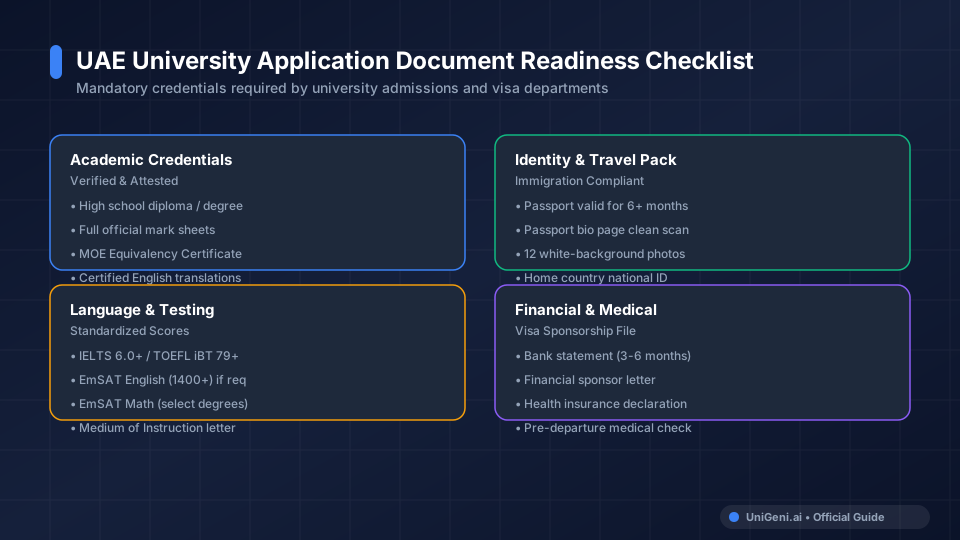
Every UAE application draws from the same core set: passport, transcripts and certificates, English evidence where required, a statement, and reference or sponsorship documents depending on the programme. The common failure mode is inconsistency, one version of your name on the passport, another on the transcript, a sponsor letter that names nobody in the file. Assemble the pack once, scan everything in colour, and reuse it.
The itemised master checklist, covering what needs attestation, translation or notarisation for each document type, is in our student documents checklist for Malaysia and the UAE. That page owns the detail. Read it before paying for any attestation service you may not need at application stage.
Step 3: Choose how to apply
You have three realistic routes, and each has genuine trade-offs.
Applying directly
Every UAE university runs its own online application portal. Applying direct costs only the application fee, keeps you in full control, and is perfectly workable if you have two or three clear choices and documents that need no interpretation. The downsides: you carry every deadline yourself, equivalence questions get answered slowly by email, and comparing fee structures across universities is your own research burden.
Applying through an agent or counsellor
Traditional agents submit applications on your behalf, sometimes for fees and sometimes on commissions paid by universities, which is worth knowing because commission arrangements can shape what gets recommended. A good counsellor earns their place on equivalence edge cases, deadline management and family communication, especially where parents want a human answer in their own time zone. The honest test is whether the agent recommends universities outside their commission network; if not, their shortlist is marketing, not advice.
Applying through a platform
Platforms sit between the two: you keep a self-service account, but applications, document checks and follow-ups run through one workflow. The Unigeni model is free to start, with a fee only when you actually submit applications, and every programme in the catalogue is a verified university listing rather than an advertised inventory. For students applying to several universities at once, the practical gain is one document pack reused everywhere with consistent naming, plus counsellor support when an equivalence or deadline question needs a human.
Step 4: Submit and pay the application fee
Application fees in the UAE are modest by global standards, commonly AED 100 to 300 per application, though they are rarely refundable, which is a second reason to shortlist before spraying applications. Heriot-Watt Dubai, for example, charges a non-refundable AED 300 processing fee, while several local private universities charge less and a few waive the fee in promotional windows. Pay by card through the official portal only, keep the receipt, and save the application reference, because every subsequent email from the university keys off it.
After submission, watch your email including spam folders daily. UAE admissions teams move quickly and a request for one missing document can expire if unanswered for a fortnight.
Step 5: Assessment, and what it involves
Most UAE admissions decisions are documents-first: the team compares your transcript against the programme's equivalence table and either admits, conditions or declines. Beyond documents, three assessment layers appear depending on the programme.
- Interviews. Business, education, psychology and some postgraduate programmes interview shortlisted applicants, usually by video call.
- Placement or entry tests. Mathematics placements for engineering and computing routes, and internal English tests where no IELTS or TOEFL score is submitted, are common; foundation programmes then use their own progression rules, such as minimum passing grades per course, to advance you into Year 1.
- Programme-specific requirements. Portfolios for design degrees and work experience for MBAs.
Nothing here is standardised across the market, so treat the admissions email as the authoritative brief and prepare for exactly what your programmes ask, not what a forum thread says.
Step 6: Read your offer correctly
Offers arrive as conditional or unconditional letters, and the difference matters at the deposit stage.
- Unconditional offers confirm admission as-is, and the deposit is purely a seat reservation.
- Conditional offers admit you subject to stated results: final transcript grades, an English score, or attested documents. Read the conditions literally. A condition of "IELTS 6.0 overall, no band below 5.5" is not met by 6.0 overall with a 5.0 band, and universities do enforce the distinction in August.
Deposits follow acceptance, and amounts vary by tier. Heriot-Watt Dubai takes a refundable AED 1,000 security deposit alongside a first instalment equal to 10 percent of the first-year fee. University of Birmingham Dubai takes a non-refundable AED 5,000 deposit, of which AED 490 is retained as a fee and the rest is credited to tuition. For a worked example of deposit, retention and instalment mechanics at one institution, our Birmingham Dubai admissions and fees guide carries the detail. Read refundability before paying, not after, especially with conditional offers, because that money is what converts an offer into an enrolment the university will sponsor.
Step 7: The visa handover
Once your deposit is paid, the university's visa office owns the immigration file. UAE student residence visas are sponsored by the institution: it applies for your entry permit, and the medical test, Emirates ID and visa stamping complete after arrival. Your job in this step is responsive, not managerial: send the passport scans and photographs exactly as requested, fund the visa charges when invoiced, roughly AED 3,000 to 8,500 in total, and book flights only after the entry permit is issued. The complete sequence, including the Dubai versus northern emirates channel difference and renewal rules, is in our UAE student visa guide 2026.
Frequently asked questions
Do I need an agent to apply to UAE universities?
No. Direct applications are open to everyone and the forms are straightforward. Agents and platforms earn their keep on equivalence edge cases, multi-university document management and family communication, not on access. If you use one, ask how they are paid before you take shortlist advice.
How many universities should I apply to?
Four to six well-matched programmes is the sensible range. Application fees are small individually but non-refundable, and each extra application splits your document-preparation attention. Depth beats spray: entry-table matches first, applications second.
Can I apply before my final results are out?
Yes, and most applicants do. Conditional offers built on interim or predicted results are standard practice, with the condition wording carrying your final grades and any English score. Just budget for the possibility that August results miss a condition, and know your university's foundation or alternative-offer policy in advance.
What actually happens after I accept an offer?
You pay the deposit, which secures the seat and often triggers the visa file, then complete any outstanding conditions and await the entry permit. From acceptance to arrival, the university drives the process and your role is fast responses and on-time payments.
Where to begin today
Shortlist four to six programmes against your transcript and budget, assemble the document pack once, and start the attestation clock early if your qualifications need it. If you want the platform route, you can start free on Unigeni and only pay when you submit applications, or talk to a counsellor if your case has an equivalence wrinkle worth a human look first.
Sources
- Heriot-Watt University Dubai fees pages (https://www.hw.ac.uk) — AED 300 application fee and deposit structure.
- University of Birmingham Dubai deposit page (https://www.birmingham.ac.uk) — AED 5,000 non-refundable deposit, from which an AED 490 fee is retained.
- GradRight study cost guide (https://www.gradright.com) — typical UAE application fee range of AED 100 to 250.
- UAE federal portal (https://www.u.ae) — university-sponsored student residence framework.
- QS TopUniversities (https://www.topuniversities.com) — reference for English requirement structures used in offer conditions.