

Malaysia vs UAE: Which Country Is Cheaper to Study In?
Malaysia vs UAE compared: tuition, living costs, work rights, visas and post-study options, with a same-student budget and a decision framework.
Comparing Malaysia and the UAE as study destinations means comparing two genuinely different products. Malaysia is a low-cost, high-volume study destination where a full degree can cost less than one year elsewhere. The UAE is a premium, career-focused market built around branch campuses, tax-free salaries and long-term visa possibilities. The headline answer to which is cheaper: a three-year bachelor's degree in Malaysia typically lands between US$25,000 and US$40,000 all-in, while the same degree in the UAE runs from roughly US$89,000 to US$154,000, recomputed from the tuition and living bands below. Both bands draw on the same research as our two cost guides, whose own headline figures are four-year totals. Cost, however, is only one of five comparisons that decide, and for some profiles the more expensive country is the better buy.
Run the head-to-head across tuition, living costs, work rights while studying, visa processing and cost, post-study options and degree recognition, then finish with a worked budget for the same student in both countries and a decision framework you can apply to your own situation. The line-by-line detail lives in the two country guides, our cost of studying in Malaysia 2026 and cost of studying in the UAE 2026, so use this page to decide direction and those pages to build the budget.
Tuition, head to head
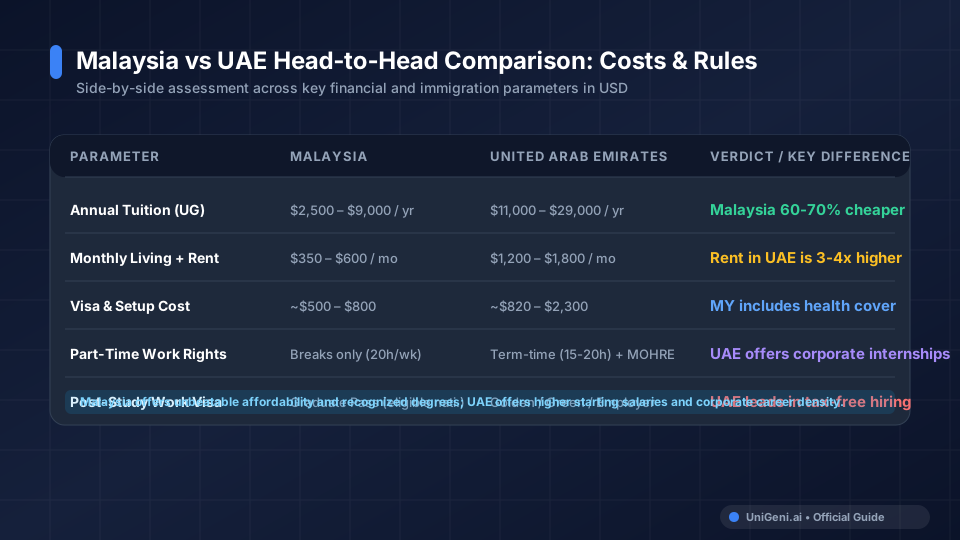
Malaysian tuition runs about RM11,000 to RM25,000 a year at public universities, RM20,000 to RM40,000 at private universities, and RM38,000 to RM80,000 at UK and Australian branch campuses. UAE tuition at international institutions commonly runs AED 40,000 to 120,000 a year, with branch campuses concentrated around AED 60,000 to 69,000 for typical degrees. Converting at roughly RM4.05 and AED 3.67 to the dollar, Malaysia's private tier sits near US$5,000 to US$10,000 a year against roughly US$11,000 to US$33,000 in the UAE, and even Malaysia's priciest branch campuses overlap the UAE's cheapest institutions. Medicine is the exception in both markets and needs separate budgeting.
Living costs, head to head
Student living in Malaysia runs RM1,500 to RM2,500 a month depending on city, with Kuala Lumpur at the top and Kuching and Penang cheaper. Dubai student living averages AED 4,500 to 6,500 a month, with accommodation the main driver. In dollar terms that is roughly US$370 to US$620 against US$1,200 to US$1,800, so over a three-year degree the living-cost gap alone typically reaches US$30,000 to US$45,000 at mid-band. Neither market requires a car.
Work while studying
The rules differ in a way that matters to tight budgets. In Malaysia, international students may work a maximum of 20 hours per week, but only during semester breaks longer than seven days, only in restricted sectors such as restaurants, mini markets and petrol stations, and only with prior approval. In practice it is break-time income, not a monthly budget line. In the UAE, students can work during term through a MOHRE student training and employment permit with a registered employer, and guides commonly describe a cap of around 20 hours a week in term, though cap details are set by MOHRE policy and should be verified with your university. If financing living costs through work is central to your plan, the UAE's term-time permission is structurally friendlier; if it is a nice-to-have, Malaysia's restriction costs you little.
Visas: processing and cost
Both countries make the university your sponsor, which removes embassy queues but ties the visa to your institution. In Malaysia the university files your Student Pass through EMGS: the charter is 14 working days for complete files, and the realistic pattern is four to six weeks to the approval letter. First-year charges total about RM3,200 to RM4,950 including medical, insurance and a refundable bond for most South Asian nationals. In the UAE the university files through ICP or Dubai's GDRFA: standard processing runs around two weeks, full status including Emirates ID completes two to five weeks after arrival, and total costs land between AED 3,000 and 8,500. The UAE is faster; Malaysia is cheaper; both punish incomplete documents equally.
Post-study options
This is where the comparison flips for some nationalities. Malaysia's 12-month Graduate Pass is limited to 33 eligible countries, and as of September 2026 Pakistan, Bangladesh and most African countries are not on it. The Employment Pass now requires a minimum basic salary of RM5,000 a month at the entry category, double the old floor, against typical fresh-graduate Kuala Lumpur salaries of RM2,800 to RM5,000. The UAE's standout is the 10-year Golden Visa for graduates with a GPA of 3.5 from universities classified A by the Ministry of Education, or 3.8 from B-classified institutions, within two years of graduating; employer sponsorship and a Green Visa at an AED 15,000 monthly salary are the other routes. A strong student wanting a long-term Gulf foothold has a clearer path there than in Malaysia today; the full mechanics are in our guides on working in Malaysia after graduation and staying in the UAE after graduation.
Degree recognition and branch campuses
Both countries host genuine branch campuses whose degrees are awarded by the parent university: Nottingham, Monash and Heriot-Watt in Malaysia; Birmingham, Heriot-Watt and Wollongong in the UAE. A branch-campus degree carries the parent name at a fraction of home-campus cost, a stronger value proposition in Malaysia where the branch premium is smaller. For UAE-bound students, the university's Ministry classification matters twice, for degree standing and for Golden Visa eligibility, so check the classification rather than the parent campus's global ranking. If you plan to work in your home country's public sector, verify recognition with your own authorities before enrolling.
The same student, side by side
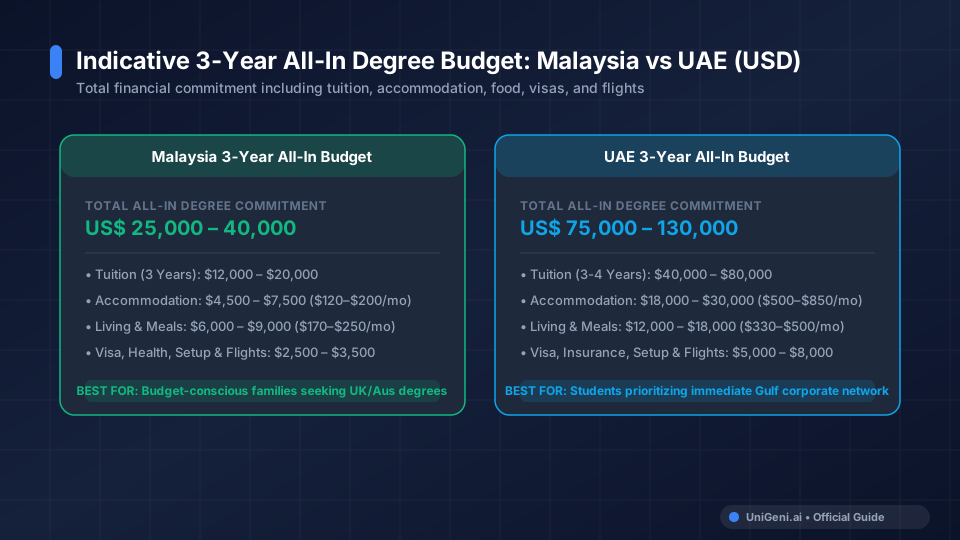
Take one profile: a Pakistani student starting a three-year business degree in late 2026, in shared accommodation, flying home once a year. In Kuala Lumpur at a mid-priced private university: tuition RM25,000 a year for three years, living at RM1,800 a month for 36 months, first-year visa and immigration charges about RM4,000, registration about RM2,000 and flights about RM6,000, totaling near RM151,800, or about US$37,500. In Dubai at a typical branch campus: tuition AED 65,000 a year for three years, living at AED 5,500 a month for 36 months, visa and Emirates ID about AED 6,000 and flights about AED 3,000, totaling near AED 402,000, or about US$109,500.
Both totals are labeled estimates built from the two cost guides' research, and both swing with choices. The UAE figure moves roughly US$89,000 to US$154,000 across the real tuition and living bands, Malaysia about US$25,000 to US$40,000. A 30 to 50 percent UAE merit award narrows the gap but rarely closes it, and Malaysian universities award merit tiers too, as our Malaysia scholarships map and UAE scholarships map set out.
A decision framework
Work through three questions in order. Budget tier: if the family can fund under US$30,000 total, Malaysia is realistically the only option. Between US$30,000 and US$60,000, Malaysia offers comfort and the UAE needs a large merit award. Above roughly US$75,000, the UAE becomes a genuine choice. Career goal: if you want Gulf labour-market exposure, a tax-free starting salary and a shot at the Golden Visa, the UAE premium buys something real; if the degree itself is the asset, the Malaysian degree delivers it at a third of the price. Nationality and work rights: check where your passport sits in Malaysia's Graduate Pass list before assuming you can stay, and weigh the UAE's GPA-linked Golden Visa against your expected grades.
When each country wins
Malaysia wins for cost, Muslim-majority familiarity, the widest choice of affordable universities, and students whose post-graduation plan points home or online. The UAE wins for term-time work rights, faster visa processing, Gulf career access, long-term residence for strong students, and families who value Gulf-city infrastructure and can fund it. Neither wins on prestige alone: the same parent-university degree is available in both markets at very different prices, which is why the decision should start with your budget tier and end with your career goal.
Frequently asked questions
Is Malaysia always cheaper than the UAE?
For like-for-like degrees, almost always: total costs differ by roughly a factor of three in our estimates. The exceptions are rare: a near-full merit award in the UAE against full fees at a premium Malaysian branch campus, or complete financial aid at NYU Abu Dhabi, which meets full demonstrated need.
Can I work part-time in both countries?
Yes, under different rules. Malaysia permits up to 20 hours a week only during semester breaks longer than seven days and in restricted sectors with approval. The UAE allows term-time work through a MOHRE student permit with a registered employer, commonly described as capped around 20 hours a week, and you should verify current conditions with your university before accepting a job.
Which country is better for staying after graduation?
It depends on your passport and grades. Malaysia's Graduate Pass excludes many South Asian and African nationalities as of September 2026 and its Employment Pass salary floor rose sharply in 2026, while the UAE offers a 10-year Golden Visa to graduates with a GPA of 3.5 or 3.8 depending on university classification. Strong students from excluded nationalities often have better UAE options; both guides are linked above.
Do employers recognise degrees from both countries?
Branch-campus degrees carry the parent university's name in both countries, and that is what most employers and postgraduate schools see. Recognition of local universities varies by employer and country, so if you have a specific home-country career path, check recognition with the relevant authority before choosing.
Choosing between them with real numbers is a one-session exercise when someone runs it with you. If you want your budget, grades and nationality mapped against both countries, talk to a counsellor for free.
Sources
- Bank Negara Malaysia (https://www.bnm.gov.my) — USD/MYR reference rate used for conversions.
- Central Bank of the UAE (https://www.centralbank.ae) — AED peg to the US dollar used for conversions.
- EMGS schedule of fees (https://visa.educationmalaysia.gov.my) — Malaysian first-year visa cost components and processing charter.
- EMGS Hub (https://hub.emgs.com.my) — Malaysia part-time work rules during semester breaks.
- ICP (https://icp.gov.ae) — UAE residence visa processing and fee components.
- MOHRE (https://www.mohre.gov.ae) — UAE student training and employment permits.