

Staying in the UAE After Graduation: Work Routes and the Golden Visa
Options after a UAE degree: the 10-year Golden Visa with GPA 3.5 or 3.8 thresholds, employer permits, the Green Visa and freelance routes, in order.
Post-study residence in the UAE means converting a university-sponsored student visa into one of three things: an employer-sponsored work permit, a self-sponsored long-term visa such as the Golden Visa or Green Visa, or a freelance permit that carries its own residence route. There is no automatic post-study work visa of the kind some countries offer, but there are several well-defined paths, and the strongest one for strong students is the Golden Visa for graduates, a 10-year self-sponsored residence permit.
The headline criteria: graduates of UAE universities classified A by the Ministry of Education need a GPA of at least 3.5, those from B-classified universities need 3.8, and the application must be made within two years of graduating. Graduates of universities outside the UAE qualify only with a bachelor's from a top-100 institution in the Ministry's classification and a GPA of 3.5 or higher. The Green Visa, the main alternative, requires a bachelor's degree and a salary of at least AED 15,000 per month. This guide explains each route, the order to attempt them, and what our partner campuses in Dubai mean for your case.
Your status the day you graduate
Your student visa does not end at the graduation ceremony. It runs until its expiry date or until it is cancelled, normally when you leave the university's sponsorship. When it is cancelled you get a short grace window to change status, apply for a new permit or arrange departure; confirm the current grace-period length with ICP or your university's visa office, because it is the one number that decides how much room you have to manoeuvre. If a job or Golden Visa application is already in progress, a status change can usually be completed inside the country rather than requiring you to exit and return on a new entry permit.
The practical implication: start your post-study planning one or two semesters before graduation, not after. Transcripts, attested degree certificates and equivalency documents take weeks to obtain, and every route below depends on them. Our full UAE student visa guide for 2026 covers the documents and sponsorship mechanics that feed into this stage.
The graduate Golden Visa
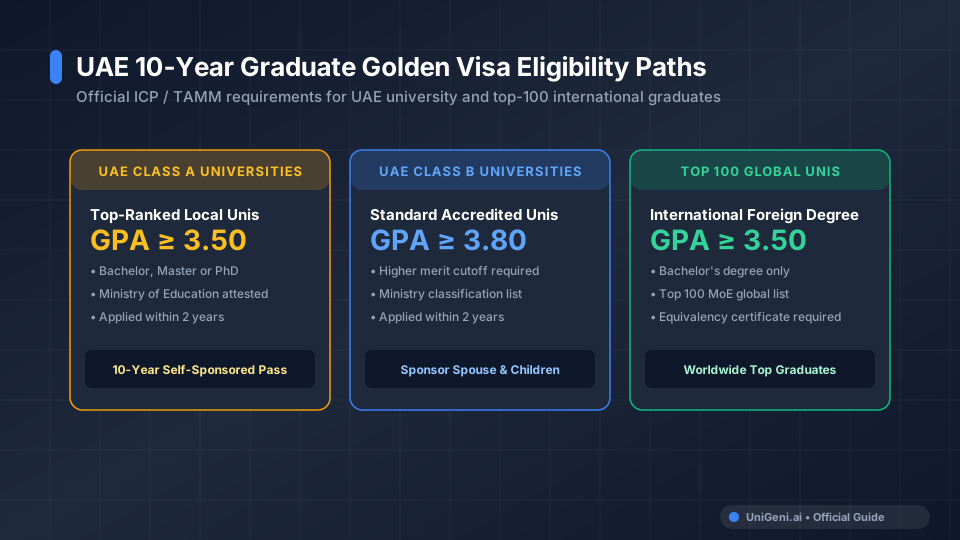
The Golden Visa is a long-term residence permit that, for graduates, runs for 10 years, does not need an employer or university sponsor, and generally allows you to sponsor your spouse and children. Abu Dhabi's official portal sets out two graduate tracks, applicable through ICP nationwide.
Graduates of UAE universities
You need a bachelor's, master's or PhD from a university accredited by the Ministry of Education and classified A or B on the Ministry's classification list. The GPA floor is 3.5 for A-classified universities and 3.8 for B-classified universities, your graduation year must be no more than two years before the application, and your degree must be attested by the Ministry. The application is filed with your final transcripts and the attested certificate, through ICP channels or, in Abu Dhabi, through the Residents Office (TAMM).
Graduates of universities outside the UAE
This track is narrower. It accepts bachelor's degrees only, from universities in the top 100 of the Ministry of Education's international classification, with a GPA of at least 3.5, within the same two-year window, and it requires an equivalency certificate from the UAE Ministry of Education on top of the attested degree.
Outstanding students
Separately, the Golden Visa framework recognises top secondary-school students, with a 98 per cent or equivalent final grade cited on the federal portal and a 95 per cent minimum on the GDRFA service page for the five-year top-students permit, plus a category for top-performing university students. If you entered university on one of these, your path to a longer permit after graduation is simpler. Verify the current cut-offs before relying on them, since these figures have shifted between announcements.
The standard route: employer-sponsored work permit
For most graduates without a 3.5-plus GPA or a top-100 degree, the realistic first step is a job offer. The employer obtains a work permit from MOHRE and sponsors your residence visa; the process mirrors your student visa in its later stages, with medical, Emirates ID and insurance, and a status change handled inside the UAE. You do not need to leave the country while the transfer is processed.
Employers in the UAE are familiar with hiring fresh graduates off student visas, and the main friction is timing: an offer that arrives after your grace window closes creates problems. This is why applications during the final semester, including internships that convert, are the most reliable route into sponsored employment.
The Green Visa
The Green Visa is a five-year self-sponsored residence permit for skilled workers. The core criteria are a bachelor's degree or equivalent, a salary of at least AED 15,000 per month, and classification as a high-level skilled worker with MOHRE. Because the salary floor excludes most entry-level offers, the Green Visa is usually a second-stage move: two or three years into a career, once pay crosses the threshold, you can switch from employer sponsorship to self-sponsorship and gain mobility between jobs. A self-employed variant exists requiring a freelance permit or proof of annual income of about AED 360,000.
Freelance permits
If your plan is independent work, design, development, content or consulting, a freelance permit gives you a legal basis to earn without an employer. In Dubai, the freelance licence from the Dubai Development Authority is listed at AED 7,500, and UAE-wide costs reported by immigration firms range from roughly AED 1,800 for a licence alone to AED 14,200 for a licence bundled with a residence visa. Processing is measured in days to weeks. A permit plus visa is a bigger upfront cost than an employer route, but it puts your residence under your own control.
Branch campuses and the ranking question
Where you study shapes which Golden Visa track you can use, and our partner campuses sit in an interesting position.
The University of Birmingham's parent institution ranked 76th in the QS World University Rankings 2026, inside the top 100 that the Ministry's international classification references, and University of Birmingham Dubai awards Birmingham degrees. The University of Wollongong ranked around 184 and Heriot-Watt around 287 in the same edition, with University of Wollongong in Dubai and Heriot-Watt University Dubai likewise awarding home-campus degrees.
Two cautions apply. First, ranking editions move each year, and the newer QS release already shows shifts in both directions, so check the edition current at your application date. Second, as a graduate of a UAE campus you are likely to be assessed under the UAE-university track, where the Ministry's A or B classification of the local institution is what matters, not the parent campus's global rank. A strong parent-campus ranking is a good sign of standing but it is not the formal test. Confirm how ICP treats your specific campus and degree before counting on either track.
A realistic sequence

- Final semester: order official transcripts, start degree attestation and, for overseas degrees, the equivalency process; attend career fairs and push internship conversions
- Graduation week: collect the attested degree certificate; if your GPA meets the bar, file the Golden Visa application through ICP or TAMM while your student visa is still live
- If the Golden Visa is out of reach: secure any credible offer and move to employer sponsorship; a shorter-chain role in your field beats waiting for a perfect title
- Years two to three: once salary crosses AED 15,000, evaluate a switch to the Green Visa; if you are independently earning, price a freelance permit against your tax and mobility goals
Common misconceptions
The Golden Visa is not automatic for every graduate: the GPA thresholds are firm and the two-year window is enforced. It is not citizenship and does not affect your passport. Employer sponsorship is not a trap to avoid: it is the normal first job arrangement and can coexist with later Golden Visa applications through experience and salary routes. And rankings alone do not decide your case: classification lists and attestation do, and an applications clerk will look at documents, not marketing claims.
Your next step is to check where you stand against the criteria above: compute your GPA, check your university's Ministry classification, and list which documents you already hold. If you are still choosing a program, our study in the UAE hub lists institutions and outcomes, and a free account on Unigeni lets a counsellor map your eligibility across visa and career routes before you commit.
Sources
- Abu Dhabi Government Golden Visa for university graduates (https://added.gov.ae) — GPA 3.5 and 3.8 thresholds and the two-year window.
- UAE federal portal Golden Visa overview (https://u.ae/en/information-and-services/visa-and-emirates-id/residence-visas/golden-visa) — federal framework and the 98 per cent top-students figure.
- GDRFA service pages (https://gdrfad.gov.ae) — five-year top-students permit and Green Visa criteria.
- Abu Dhabi Residents Office (https://adro.gov.ae) — Green Visa salary floor and self-employed variant.
- Dubai Development Authority (https://dda.gov.ae) — freelance licence at AED 7,500.
- QS World University Rankings (https://topuniversities.com) — 2026 positions for Birmingham, Wollongong and Heriot-Watt.