

Malaysia university intakes: planning and historical examples
Understand Malaysia intake planning using historical examples, then verify current course-specific dates with the university and build your preparation checklist.
Malaysian universities do not run one admissions season. They run three main intake windows, each with its own application deadlines: February and March, June and July, and September and October. The September and October window is generally the largest and has the most programmes and scholarship money attached to it. The mid-year and start-of-year windows suit foundation programmes, branch campuses and students who missed the autumn rush. Because your Student Pass is processed through EMGS rather than issued instantly, the realistic planning number is four to six months from complete application to arrival, not weeks.
This guide is for anyone choosing when to apply: students finishing school this year, families working out finances, and applicants already holding documents who wonder if they can still catch the next intake. It covers what each intake window is, how public and private universities differ on deadlines, the document lead times that quietly decide your timeline, and a worked backwards plan for the next major intake after September 2026. For the wider picture of choosing Malaysia, start with the study in Malaysia hub. This page stays on timing and does not repeat cost or visa detail covered elsewhere.
The three main intake windows
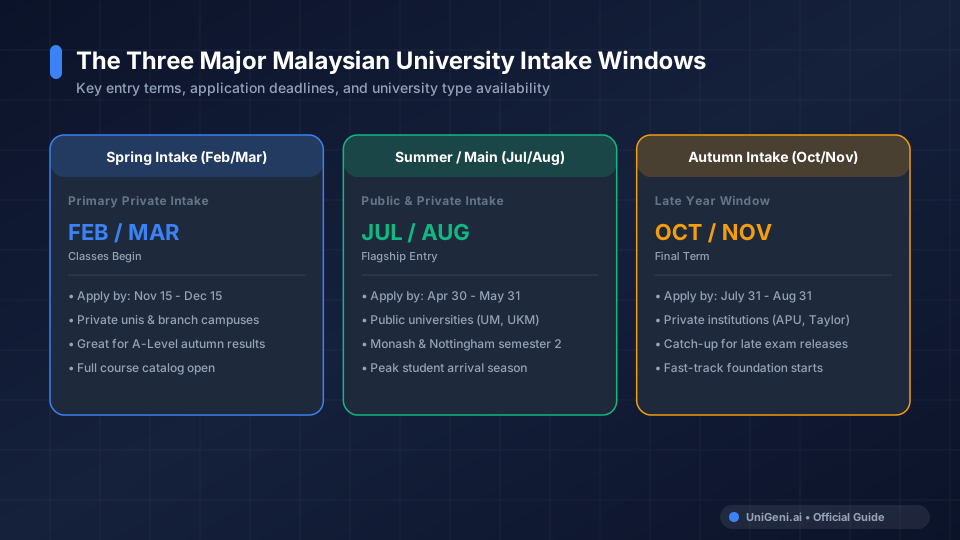
September and October: the main intake
Most universities slot their biggest cohort into the northern autumn. Orientation runs late August through September, teaching starts late September or early October, and programme choice is widest, from foundation to PhD. Scholarship consideration for the main intake is also strongest because that is when universities distribute their annual merit awards. If you have a target university and a scholarship goal, this is the window to build your plan around.
February and March: the second window
The start-of-year intake suits students whose results arrive late, whose documents took longer than expected, or who want a smaller intake with less competition for housing. Branch campus and private university calendars commonly open here. Monash University Malaysia, for example, runs February, July and October teaching periods, so a February start is a full entry point rather than a leftover one.
June and July: the mid-year window
Foundation programmes and diploma routes often start mid-year, plus a spread of degree programmes. UCSI University, for instance, structures its calendar around January, May and September intakes. If your school results come out around spring, a June or July foundation start can save you nearly a year compared with waiting for autumn.
Public and private universities keep different clocks
Private universities and branch campuses mostly use rolling applications with a practical cutoff. Heriot-Watt University Malaysia states that it accepts applications all year round for its three main intakes. Taylor's University asks for applications at least eight weeks before an intake start. International students need far more than that because of visa processing. In practice, private institutions keep accepting applications until seats for that intake fill, and popular programmes close early on their own.
Public universities run fixed application windows instead. Universiti Teknologi Malaysia, for its September 2026 postgraduate intake, ran coursework applications from 1 April to 31 July 2026 for international applicants and to 31 August 2026 for Malaysians. Research programme applications were open to all from 1 April to 31 October 2026. Those windows are announced per cycle, so check the admissions page of the specific public university each year rather than assuming last year's dates.
One pattern matters more than any single date: international deadlines land earlier than domestic ones, often by one to several months. For its September 2026 intake, the University of Nottingham Malaysia closes international applications on 31 July 2026, while Malaysian applicants can apply until 18 September 2026. Its foundation intake starting April 2026 closed earlier still, on 27 February 2026 for international applicants against 10 April 2026 for Malaysians. The gap exists because your documents must clear EMGS, immigration checks and visa issuance before you can board a flight. Whenever you see a deadline, ask whether it is the international one.
Work out your timeline backwards
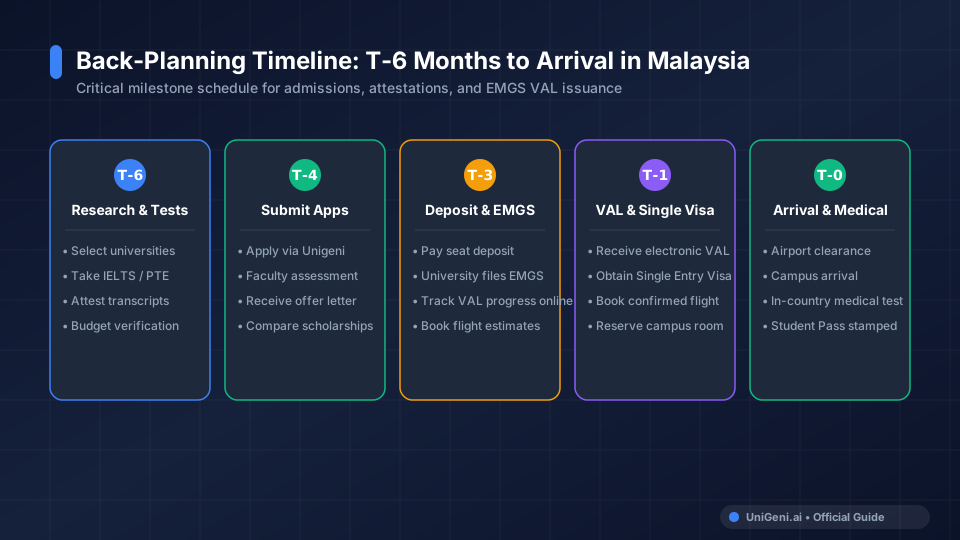
Historical planning illustration written in September 2026, not a current application or visa schedule: the February and March 2027 window.
- Enrolment and orientation, mid-February to early March 2027. This earlier planning example is not a confirmed course schedule. Monash's official February 2027 calendar lists orientation on 22-26 February and classes from 1 March 2027. Confirm the applicable course and international application deadline on the official intake page.
- Arrival in Malaysia, late January to early February 2027. You should land with your visa approval letter already in hand, ideally with a few days to settle housing and complete the post-arrival medical screening window.
- eVAL and visa stage, December 2026 to January 2027. The electronic Visa Approval Letter must be issued, then, if your nationality requires it, a Single Entry Visa obtained. Budget four to six weeks from EMGS submission to eVAL in normal conditions.
- EMGS submission, October to November 2026. Your university can only submit the Student Pass application after you accept your offer and pay the initial fees, so acceptance must happen by early October.
- Application and offer, September to October 2026. This was an illustrative September 2026 plan, not a current application recommendation. Check the exact course and applicant-category deadline before choosing this intake.
- Document file ready, now through early October 2026. This is the crunch point and the part you fully control.
If your documents are not close to ready, do not force February. Target the June and July 2027 window, or the big September and October 2027 intake, and finish your document file by early 2027 with comfortable margins. A rushed file that gets returned by EMGS costs more time than a later intake ever will.
The document lead times that decide everything
Three lead times quietly govern your start date.
- Transcripts and certificates. Certified copies of your latest results are straightforward. Applicants from Pakistan, Bangladesh, Nigeria and much of MENA often need attestation chains on academic documents, which take weeks at home-country education boards and foreign ministries. Start this before you start university shortlisting if your target intake is near. Our student documents checklist for Malaysia and the UAE lists the full pack.
- English proficiency. IELTS, TOEFL, PTE and MUET each need booking lead time and results processing, and retakes are common. Book a test date at least two months before your application deadline, or check whether your university accepts an English-medium instruction letter or an internal test.
- Passport validity. UCSI University, like most institutions, requires your passport to have at least 18 months of validity from admission. A passport expiring inside your study period should be renewed before the EMGS file opens, because changing passport details mid-process causes mismatches and delays.
For how the submission stage works after your university opens the file, read the Malaysia student visa EMGS guide. The official EMGS client charter is 14 working days for a complete application, but universities advise planning around three months end to end, so treat that charter as the floor, not the plan.
Late application options
Missing a published deadline is not always the end. Private universities with rolling admissions frequently extend intake windows when seats remain, and a phone call from you or your counsellor can confirm space in days. Foundation and diploma programmes have the most start dates across a year, so a late degree applicant can often enter a pre-university route immediately and progress on schedule. Deferring an existing offer to the next intake is usually a form rather than a new application, and your paid deposit normally carries over.
What has no flexibility is the EMGS floor. No university can enrol you in Malaysia before your visa approval (eVAL) is issued and you have entered on it. Arriving on a tourist pass to sort it out later is a serious mistake that can end the application entirely. If the visa clock cannot finish before teaching starts, choose the next intake and use the extra months for scholarship applications, which is exactly how strong applicants turn a missed deadline into a better offer. For the application stage itself, our step-by-step guide on how to apply to universities in Malaysia walks through shortlisting, forms and offers.
Frequently asked questions
Can I still apply if the deadline has passed?
At private universities, often yes, because applications stay open until seats fill. At public universities, rarely, because their windows are fixed. In both cases the real limit is not the deadline but the EMGS processing time between your offer and your travel.
Which intake is best for scholarships?
The September and October intake carries the most scholarship funding, since universities distribute their main merit awards for the academic year starting then. February applicants usually compete for whatever funds remain, though some universities hold separate budgets per intake.
Do all universities use the same intake months?
No. Most follow the February, mid-year and autumn pattern, but exact months differ. UCSI runs January, May and September, Monash Malaysia runs February, July and October, and some foundation programmes add extra starts. Always confirm on the university's own academic calendar.
How early is too early to apply?
For most private universities, applying eight to twelve months before intake is fine and can secure early scholarship consideration. Public universities only accept applications inside their announced windows, so early preparation goes into documents, not the form itself.
If you want your intake plan checked against real deadlines for your programme list, create a free account on Unigeni and a counsellor will map your document readiness, target intake and visa timeline in one pass.