

How to Apply to Universities in Malaysia: Step-by-Step 2026
The 2026 market-level walkthrough for Malaysia applications: shortlisting, documents, direct versus counsellor routes, offers, deposits and next steps.
Applying to a Malaysian university is a market process, not a central one: there is no national admissions portal, each university runs its own intake, and international applications go through the university's own system or its authorised representatives. This guide shows how to apply to universities in Malaysia step by step, at market level. A typical application costs between nothing and RM 300 in fees, takes one to three weeks to earn an offer when the file is complete, and then feeds directly into the EMGS Student Pass stage that follows acceptance. Students who start three to six months before their intake move through calmly; students who start late compress every stage and pay for it in stress and expedited fees.
This guide walks the whole application sequence at market level: how to shortlist against real entry requirements, what documents to prepare, whether to apply directly or through a platform or counsellor, what your offer letter actually means, and what accepting it triggers. The document-by-document detail lives in our student documents checklist for Malaysia and the UAE, and the visa stages after acceptance are covered fully in our Malaysia student visa EMGS guide; both are linked at the steps where they matter. For the wider destination picture, start with the study in Malaysia hub.
What this guide covers
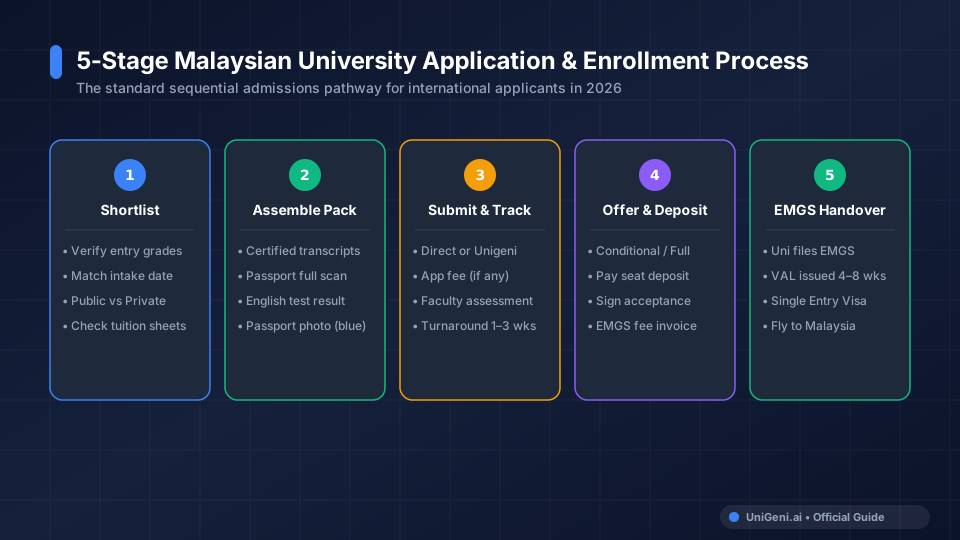
- Shortlisting universities against your actual qualifications and budget
- Preparing the document pack before you touch an application form
- Choosing between applying directly, a platform, or a counsellor
- Reading your offer: conditional versus unconditional
- Accepting, paying the deposit, and what happens next
Step one: shortlist against real entry requirements
Before any form-filling, build a shortlist of three to five programmes you can actually enter and afford. Entry requirements in Malaysia map qualifications to levels. O Level, SPM and WAEC-class certificates qualify you for foundation and diploma programmes. A Levels, STPM, the International Baccalaureate, diplomas and completed foundation years open direct bachelor entry. A recognised bachelor's degree qualifies you for master's programmes. Each university publishes its own grade floors, and competitive programmes fill well above them, so read the programme's entry page rather than the university's marketing page.
Layer three filters over that: total cost including living expenses, intake dates, and institution type. Tuition bands run roughly RM 11,000 to RM 25,000 a year at public universities, RM 20,000 to RM 40,000 at local private universities, and RM 50,000 to RM 80,000 at UK and Australian branch campuses. Malaysia's main intakes fall in February and March, mid-year around July, and September to October, with private universities often adding January, May and September rounds. Work backwards: if your documents need attestation, and most do, the application itself is not the longest pole in the tent. Our Malaysia university intakes and deadlines guide carries the timing detail.
Step two: assemble the document pack
Applications stall on documents more than on anything else, so prepare the pack before you apply anywhere. The core file is a passport valid well beyond your intended course dates, academic certificates and transcripts, certified translations for anything not in English, English test results where required, and a sponsor or funds statement. Documents from countries with attestation systems, including Pakistan, Bangladesh and Nigeria, usually need their education ministry's authentication before the visa stage even if the university accepts copies at admission.
Do not self-certify translations or crop scans: poor document quality is one of the most common reasons university files get rejected. The full list, including photo specifications and sponsorship letters, is in the student documents checklist, which is kept current for both Malaysia and the UAE so you can reuse one pack across applications.
Step three: choose how to submit
Applying directly
Applying direct means using each university's own application portal or email-based admissions. The upside is zero intermediary cost and full control. You pay only the application fee, which ranges from nothing at some private universities to RM 100 at Monash Malaysia and Xiamen University Malaysia. Public universities charge around RM 300, for example Universiti Malaya. The downsides are real. You carry every document error yourself, you must track each university's deadlines and follow-ups separately, and when the EMGS stage begins after acceptance there is no one whose job it is to chase your file. Direct suits applicants with strong documents, time, and one or two target universities.
Applying through a platform or counsellor
Platforms and counsellors exist because the market is fragmented: dozens of universities, different intakes, different document rules. A good intermediary shortlists against your grades and budget, pre-checks your documents before submission, applies on your behalf, and then manages the visa-stage handoff, which is where most self-managed applications wobble.
Be honest about the trade-offs. Some agents represent a limited panel of universities and push commission-linked choices, and some charge upfront fees regardless of outcome. Judge any intermediary on three questions: do they show you universities outside their commercial interest, do they put programme and fee details in writing, and does their cost structure reward your success?
Unigeni's model works this way. It is free to start, and you browse verified programmes with published fees. A counsellor handles your submission and the EMGS process after acceptance. The platform's fee is charged on submission, not for account access. Whether you apply through Unigeni, another counsellor, or directly, the sequence in this guide is the same one your file will follow.
Step four: understand your offer letter
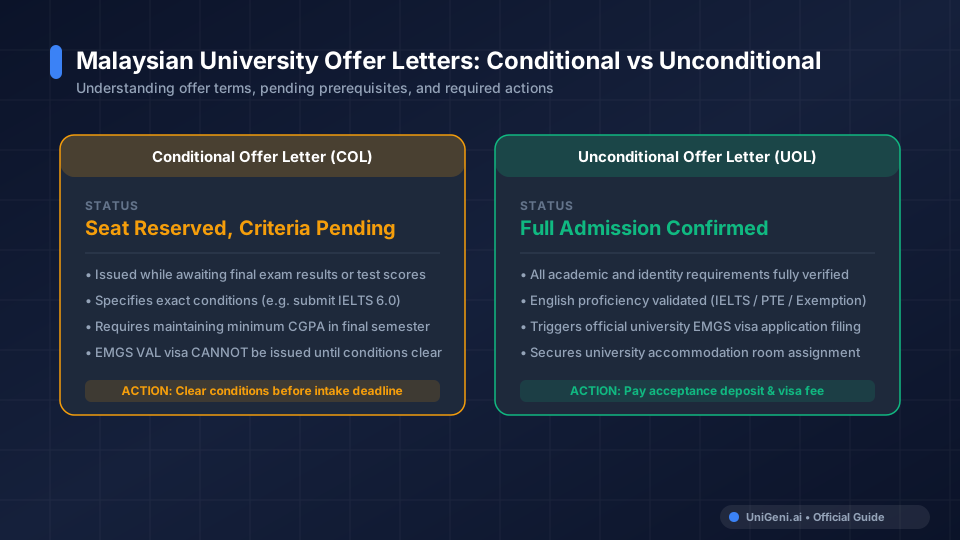
Offers arrive as email letters, typically within two to three weeks of a complete application at private universities, longer at public universities and for medicine. There are two kinds, and the difference matters.
- Conditional offer. You are accepted subject to conditions: final results you have not yet received, an English test score you have not yet taken, or attested documents still in process. Conditional offers let you lock a place early, and most international applicants hold one at some stage.
- Unconditional offer. Every condition is met and your file is complete. Only an unconditional offer can be accepted for enrolment, so your working goal is to convert conditions into evidence as fast as your exam boards and embassies allow.
Read the offer for four things beyond the congratulations: the intake date, the fee schedule and what it includes, the deposit required to accept, and the deadline for acceptance. Offers expire, and popular programmes do re-offer unfilled places.
Step five: accept and pay the deposit
Accepting an offer is usually a signed acceptance form plus a deposit or first-semester payment. Deposit sizes vary widely, from a few hundred ringgit to a first-semester invoice, and some or all of it is typically credited against your first fee bill rather than being an extra cost. This is the moment your application becomes a commitment: it typically starts the university's EMGS file, so have your sponsor statements and attested documents ready now, not after you pay. Keep the payment receipt; you will present it more than once.
What happens next
After acceptance and deposit, the university registers your Student Pass application with EMGS, and the visa sequence, the approval letter, the single entry visa for nationalities that require one, and the post-arrival medical screening, runs on its own clock of roughly six to ten weeks in normal conditions. The EMGS visa guide walks that stage in full; the only application-level advice that carries over is the same throughout: complete files move, incomplete files stall.
Questions applicants ask
How many universities should I apply to? Three to five is the working range: enough for a real price and grade comparison, few enough to manage document follow-ups properly. Each direct application carries its own fee; platforms often bundle submission.
Do I need an agent? No. Direct application is entirely possible with strong documents and time. A counsellor is worth it when your qualifications need interpretation, your corridor requires attestation, or you want the visa stage managed alongside admissions.
Can I accept two offers? Technically you can hold conditional offers in parallel, but paying deposits at two universities usually forfeits one. Convert conditions, compare the final numbers, then commit once.
What if my final results miss my conditional offer? Tell the university immediately. Depending on how far you missed, they may confirm the place, move you to a related programme, or route you through a foundation or diploma that leads to the same degree a year later.
When is too late to apply? As a rule, hold a complete file three to six months before your intake. Applications that start inside eight weeks to a September intake can still work at quiet universities, but you are gambling with the visa stage, not the offer.
If you want the shortlisting, pre-checks and EMGS handoff handled in one place, start free on Unigeni and a counsellor will run your applications against live intakes.
Sources
- Education Malaysia Global Services (https://visa.educationmalaysia.gov.my) — what follows acceptance and the single entry visa stage.
- Monash University Malaysia (https://www.monash.edu.my/study/undergraduate/fees) — published RM 100 application fee benchmark at a branch campus.
- Universiti Malaya (https://study.um.edu.my) — RM 300 international application fee example at a public university.
- Times Higher Education (https://www.timeshighereducation.com) — student pass processing times of four to six weeks and early application advice.
- EasyUni (https://www.easyuni.com) — 2026 application deadlines and intake breakdowns.
- APU via university guidance pages (https://www.apu.edu.my) — two to three week offer turnaround for complete international files.