
Study in UAE From Pakistan: The Complete 2026 Guide
A Pakistan to UAE roadmap for 2026: equivalences, IBCC HEC and MOFA attestation, proof of funds, budgets in AED and PKR, visas and scholarships.
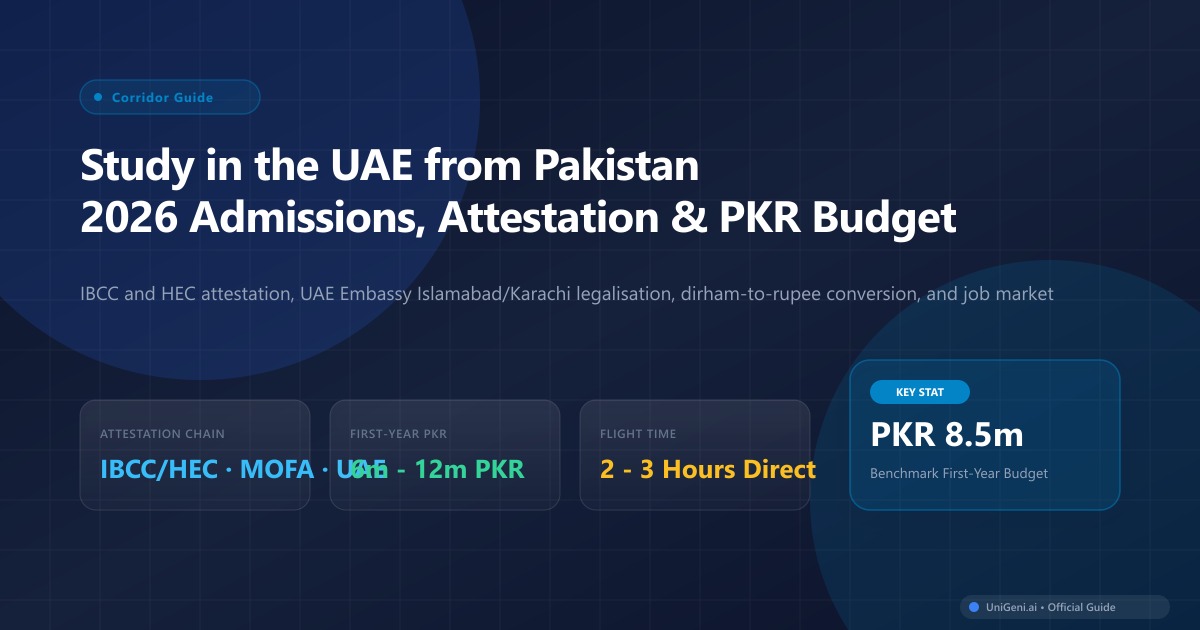
This guide covers how to study in the UAE from Pakistan in 2026, from choosing a Dubai or Sharjah campus to arriving with your residence visa in process. Pakistan is one of the largest source countries for UAE higher education. Pakistani students made up about 7 percent of international enrolments at Dubai's private institutions in 2024-25, the second-largest group after India, according to KHDA data. Across the UAE as a whole, higher education institutions admitted 57,035 new students that year, up 13 percent. Flights take two to three hours, and the dirham sits near PKR 75 to 76 as of mid-September 2026.
The practical journey takes three to four months: shortlist universities, meet their equivalences, complete the attestation chain, show funds, accept an offer and pay the deposit, then let the university sponsor your student visa. This page covers the Pakistan-specific parts; the general walkthrough is in our how to apply to universities in the UAE guide.
Why the UAE attracts Pakistani students
Four reasons come up consistently in this corridor.
- Proximity. Karachi is about two hours from Dubai by air, Lahore and Islamabad around three. Students come home for Eid without wrecking a semester budget, and parents visit easily.
- Tax-free careers. The UAE levies no personal income tax, and graduates step into a large English-speaking job market across finance, logistics, engineering and technology, with longer-term residence possible for graduates of well-ranked universities under the Golden Visa route.
- Branch campuses. Dubai hosts overseas campuses of British, Australian and other universities, so a Pakistani student can read for a foreign degree two time zones from home. Heriot-Watt, Birmingham, Wollongong and Middlesex all operate here, and the wider campus landscape is in our study in the UAE overview.
- The Pakistani community. Pakistanis are among the largest expatriate communities in the UAE, with estimates of 1.5 to 1.9 million people, concentrated in Dubai and Sharjah. Halal food is everywhere, Urdu is widely heard, and Pakistani schools and cricket leagues ease the adjustment.
What UAE universities require from Pakistani applicants
For a bachelor's, the standard qualification from Pakistan is the Intermediate or HSSC, meaning FA, FSc, ICS or I.Com, and each university sets its own minimum percentage. One published example: Heriot-Watt University Dubai lists the Pakistan Intermediate Certificate with a typical requirement around 70 percent. Thresholds move by programme and intake year, so treat your target university's country list as the deciding document. If your scores fall below direct entry, foundation or degree-entry programmes are the standard bridge.
For a master's you need a recognised bachelor's degree. Pakistani four-year BS degrees are generally accepted; two-year BA or BSc holders are sometimes asked for additional assessment or a bridge programme.
English evidence is usually IELTS or TOEFL where a test is required, but UAE universities are flexible: many run their own placement tests, accept prior English-medium study, or admit you into a foundation year that carries the language component. Check the specific programme rather than assuming one market-wide rule.
The attestation chain for UAE-bound documents
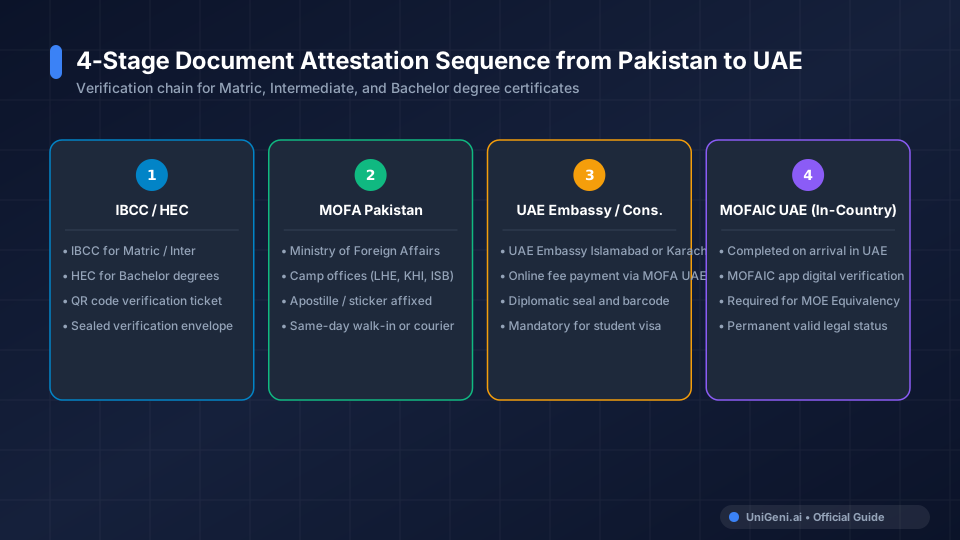
Pakistani documents are made usable abroad through a fixed sequence: the education body first, then Pakistan's Ministry of Foreign Affairs, then the UAE Embassy in Islamabad. Where asked, the UAE's own Ministry of Foreign Affairs inside the country comes last. Skipping a link is the most common way a file stalls.
IBCC for school certificates
The Inter Boards Coordination Commission attests Matric and Intermediate certificates, the first link when a UAE university or authority asks for attested school documents. If you hold O or A Levels, you may also need an IBCC equivalence certificate converting the foreign qualification to the national standard.
HEC for degree-level documents
The Higher Education Commission attests degrees, transcripts and provisional certificates through its e-portal at eportal.hec.gov.pk, with counters in Islamabad, Karachi and Lahore and courier options elsewhere, at a published fee of Rs 1,000 per original document and Rs 700 per photocopy. HEC attestation matters mainly for master's applicants and later use of your degree; for a first bachelor's application, universities usually ask only for certified copies, so confirm before paying.
MOFA Pakistan, then the UAE Embassy
After the education body, the Ministry of Foreign Affairs attests educational documents at Rs 3,000 per document through its online services. The UAE Embassy in Islamabad then legalises them through the UAE Ministry of Foreign Affairs platform using UAE PASS, at charges commonly around AED 300 per document. Processing guides suggest 5 to 10 working days for HEC, 3 to 5 for MOFA Pakistan and one to three weeks for the embassy, so run this chain in parallel with your applications rather than after them. A few universities additionally ask for MOFA UAE attestation after arrival; your admissions office will say so.
Proof of funds
UAE universities and their visa offices want comfort that you can pay tuition and live in the country. In practice that means recent bank statements covering three to six months. They can be in your name or your sponsor's, with sponsor letters and ID copies where a parent funds you. Third-party guidance commonly cites balances of AED 30,000 to 50,000 as comfortable, but this is not a published federal minimum: each university sets its own expectation. The rule that decides outcomes is consistency. The sponsor named in your application should match the account holder, and sudden large deposits invite questions during a visa file.
What it costs in dirhams and rupees
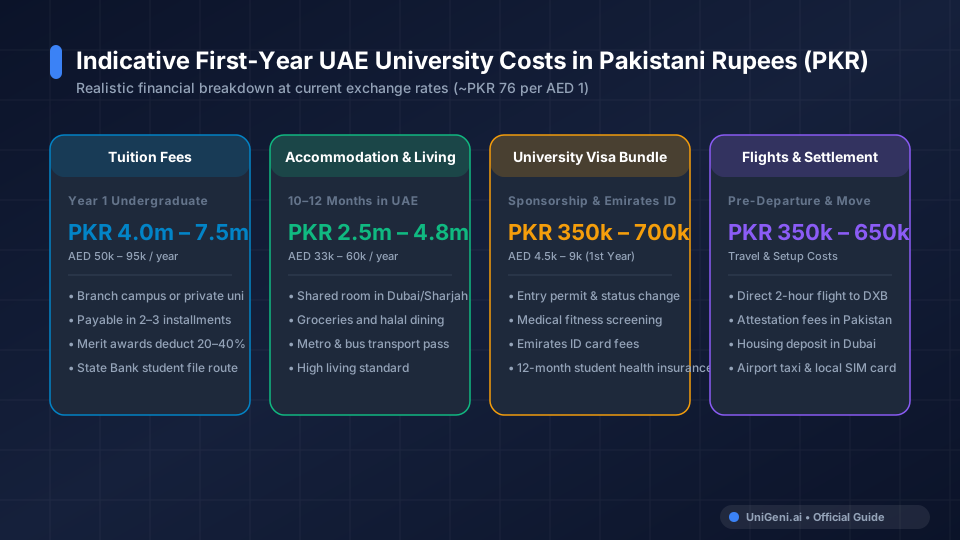
Tuition runs from roughly AED 40,000 per year at affordable local institutions to well over AED 100,000 at British branch campuses, with the field-by-field breakdown in our cost of studying in the UAE 2026 guide. Living costs are the other half: shared housing plus food and transport commonly lands between AED 3,500 and 6,500 per month, Dubai at the upper end and Sharjah cheaper. At roughly PKR 75 to 76 per dirham, a mid-range AED 5,000 month is about PKR 380,000, and a year of living costs alone is realistically PKR 3 to 5 million. Plan against both numbers and mid-degree surprises disappear.
The visa flow, briefly
You do not queue at a UAE embassy in Pakistan for a study residence visa. The system works through university sponsorship: once you accept your offer and pay the deposit, your university's visa office applies for the entry permit, and the medical test, Emirates ID and stamping happen after arrival. Budget roughly AED 3,000 to 8,500 for the visa package and two to five weeks of processing after arrival. The full walkthrough, including Dubai versus northern emirates differences, is in our UAE student visa guide 2026.
Flights and arrival
One-way fares from Karachi, Lahore and Islamabad to Dubai generally start around PKR 30,000 to 45,000. Typical direct fares sit nearer PKR 55,000 to 70,000, and flying into Sharjah on low-cost carriers is often cheaper. Treat these as indicative, since fares move with fuel and season. Book after your entry permit is confirmed, carry originals in hand luggage, and bring some dirhams in cash for the first week.
Life in the Pakistani student community
With one of the largest Pakistani populations abroad just outside campus, community life takes care of itself: student associations, Eid and Ramadan events, weekend cricket, and Pakistani groceries across Dubai and especially Sharjah. Many families choose Sharjah accommodation for lower rent while studying in Dubai, since the commute between emirates is routine. Students who settle fastest arrived with attested documents, sorted funds and a first-month budget.
Scholarships and funding for this corridor
Merit tuition discounts are common across UAE universities, and some awards target international or regional cohorts. The landscape, from branch-campus merit awards to larger competitive scholarships, is in our scholarships in the UAE for international students guide. One note for readers arriving from our Pakistan pages: the Xiamen University Malaysia tuition waiver we publish for Pakistani applicants is a Malaysia-only offer and cannot fund UAE study. For the other corridor, our study in Malaysia from Pakistan guide covers that country's separate EMGS process.
Frequently asked questions
Is my Pakistani Intermediate enough for direct entry to a UAE bachelor's?
Usually yes. Universities accept the Intermediate or HSSC with their own thresholds, commonly around 60 to 70 percent, and direct you to a foundation when scores fall short. Heriot-Watt Dubai's published figure of around 70 percent is a reasonable branch-campus benchmark.
Do I need UAE Embassy attestation before I can even apply?
Not for the application itself; universities assess scans and certified copies first, with attestation mattering at offer acceptance, visa filing or equivalency stages. Start the chain early anyway, since the embassy step can take one to three weeks and it runs in order: IBCC or HEC first, then MOFA Pakistan.
Can I work part-time in the UAE as a Pakistani student?
Yes, but only with a permit, through the MOHRE student system with your university's involvement and a registered employer, with term-time hours commonly capped around 20 per week. Earnings help with living costs, not tuition, so budget without assuming job income.
How much should my family show in bank statements?
There is no published federal minimum. Commonly cited figures are AED 30,000 to 50,000 held over three to six months, but your university's requirement governs. Consistency between the sponsor, the account holder and the application matters more than the number.
Where to start
Pick two or three universities whose equivalences you clearly meet, open the attestation chain in parallel with your first application, and set the funds history running this month rather than later. To have your shortlist, documents and visa timeline mapped by someone who works this corridor weekly, talk to a counsellor or start a free application on Unigeni.
Sources
- University World News (https://www.universityworldnews.com) — KHDA 2024-25 data on the nationality mix of international enrolments at Dubai private higher education institutions, June 2025.
- UAE MoFA attestation service (https://www.mofa.gov.ae) — embassy legalisation and UAE PASS attestation process.
- HEC e-portal (https://eportal.hec.gov.pk) — degree attestation fees and channels.
- MOFA Pakistan apostille services (https://apostille.mofa.gov.pk) — Rs 3,000 per educational document.
- Heriot-Watt University Dubai (https://www.hw.ac.uk) — Pakistan Intermediate Certificate around 70 percent entry benchmark.
- XE and Alanchand (https://www.xe.com) — AED to PKR mid-market rate, September 2026.