

Student Visa Requirements for International Students: Malaysia vs UAE
The student visa and residence-permit requirements every international student needs, plus how Malaysia's EMGS Student Pass and the UAE's ICP visa compare.
A student visa is the legal permission, usually stamped in or attached to your passport, that allows you to live in a country for the sole purpose of studying at one of its recognised institutions. It is not the same as admission. A university can accept you, but only the immigration authority of the country decides whether you may enter and stay. If you are choosing between Malaysia and the UAE, both systems are predictable once you know what each one asks for.
This overview explains the requirements almost every destination shares, how the Malaysian and Emirati systems differ in practice, and what to prepare before you start. Each country also has a detailed step-by-step guide on our content hub, linked below.
The requirements that follow you everywhere
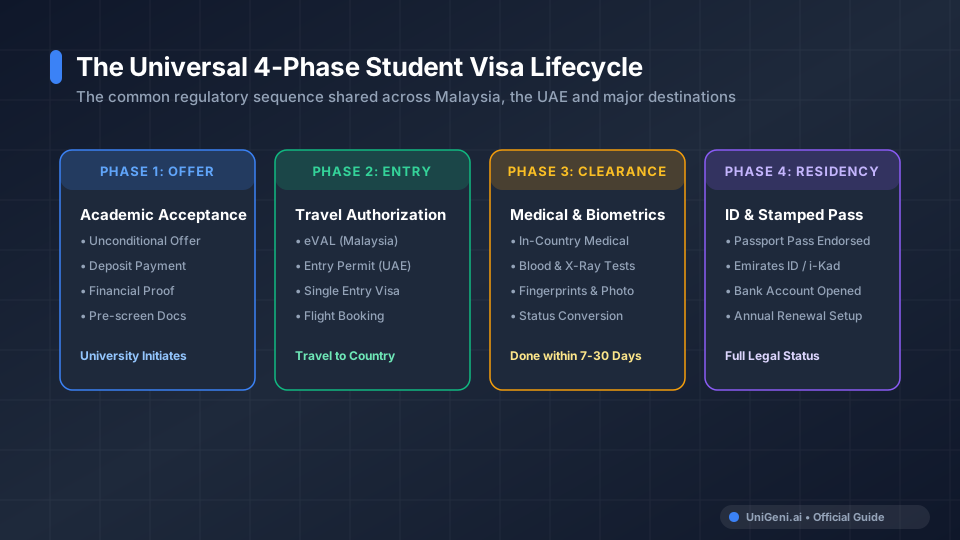
Whatever the destination, student visa applications rest on the same handful of documents. Immigration departments phrase them differently, but the underlying questions are identical.
A valid passport. Your passport must remain valid well beyond your travel date. The UAE generally asks for at least six months of validity, while Malaysian guidance for the Student Pass usually works with 12 months or more. Renew first if you are close to either threshold, because renewing mid-application slows everything down.
Proof of admission. You need an offer letter from a licensed institution. This is the anchor document. In both Malaysia and the UAE the university initiates or supports the visa process, so nothing moves until admission is confirmed.
Evidence of funds. You must show that tuition and living costs are covered, typically through bank statements, sponsor letters or scholarship award letters. Exact expectations are set by the institution during the application, so ask early. Our scholarships overview explains how award letters count toward this requirement.
Medical clearance and insurance. Malaysia requires a medical screening after arrival at an approved clinic, while the UAE requires a medical fitness test, normally a blood test and chest X-ray, before the residence visa is issued. Both countries also require health insurance for the duration of your stay, usually arranged through the university.
Biometrics and photographs. Recent passport photographs are standard everywhere, and both systems capture biometric data, most visibly the Emirates ID fingerprints in the UAE and biometric recording when your Malaysian pass is endorsed.
Malaysia: the EMGS Student Pass
Malaysia issues international students a Student Pass rather than a conventional visa sticker, and the process is managed through Education Malaysia Global Services, known as EMGS. After your university registers the application, EMGS reviews your documents, obtains immigration approval and issues the eVAL, the electronic Visa Approval Letter, which you use to travel. The pass itself is endorsed in your passport after you arrive and clear your medical screening.
EMGS publishes a processing target of about 14 working days once your file is complete, but students commonly report three to six weeks from application to eVAL, and longer around peak intakes. Government and EMGS charges, plus medicals and insurance, typically total a few hundred US dollars, with the exact amount depending on the institution type.
Two rules catch applicants by surprise. First, part-time work is capped at 20 hours per week and allowed only during semester breaks longer than seven days, with prior immigration approval. Second, after graduation there is a post-study route for eligible graduates to remain in Malaysia and look for work, but full-time employment still requires converting to a proper employment pass. The full sequence, with timelines and fees, is in our Malaysia EMGS Student Pass guide, and the wider context sits on the study in Malaysia page.
The UAE: a university-sponsored ICP visa
The UAE system is structurally different. There is no self-sponsored student visa. Your university is your sponsor, and the residence visa is issued by the Federal Authority for Identity and Citizenship, ICP, through the institution. In practice you receive an entry permit, travel, then complete the medical fitness test, Emirates ID biometrics and visa stamping inside the country, generally within 60 days of entry.
Timelines are usually shorter than Malaysia's. The entry permit is commonly issued within three to ten working days, and the residence visa follows within two to three business days after your medical results clear. Total visa costs quoted by universities and agents usually fall between AED 5,500 and AED 10,000, which bundles government fees, medical testing, Emirates ID and health insurance, and is normally paid to the university rather than to the authorities directly.
Work rules are more flexible in daily practice. Students may take part-time work, commonly cited at up to 20 hours per week during term, but only with a work permit from MoHRE, the human resources ministry, and a no-objection certificate from the university. After graduation the UAE does not rely on a single national post-study pass; graduates move to an employer-sponsored work visa, the Green Visa for skilled workers, or a job-seeker arrangement depending on the offer. The complete document list and process walkthrough are in our UAE student visa guide, with broader context on the study in the UAE page.
Malaysia and UAE side by side
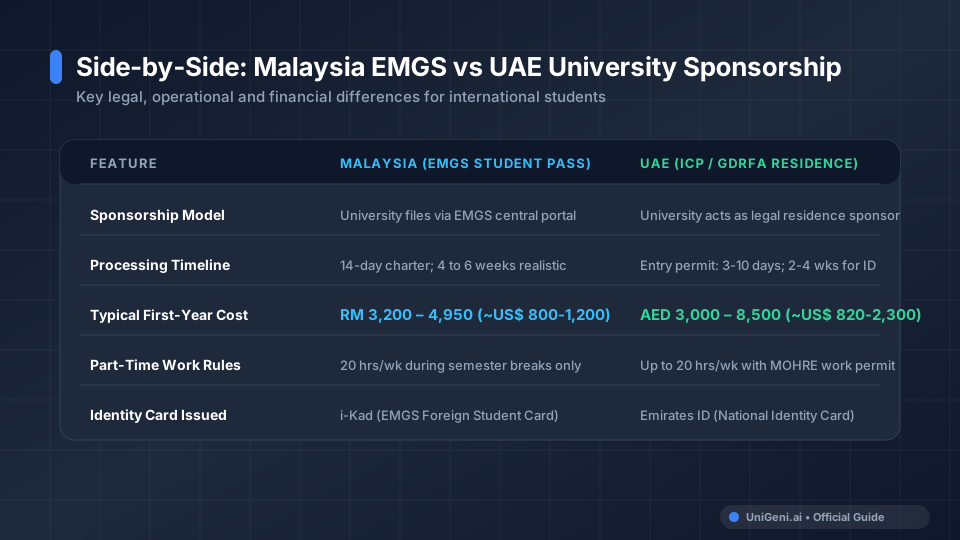
- Processing time. Malaysia: about 14 working days as the EMGS target, with three to six weeks commonly reported to eVAL. UAE: entry permit in three to ten working days, residence visa within days of medical clearance.
- Typical cost. Malaysia: roughly USD 300 to 450 in EMGS and government charges plus medicals and insurance. UAE: AED 5,500 to 10,000 all-in, usually paid through the university.
- Visa validity. Both are typically issued for one year and renewed annually for the duration of the programme.
- Work during study. Malaysia: 20 hours per week, semester breaks longer than seven days only, prior approval needed. UAE: part-time work possible with a MoHRE permit and university approval.
- After graduation. Malaysia: a post-study pass to seek employment, then an employment pass. UAE: transition to a sponsored work visa, the Green Visa or a job-seeker arrangement.
A checklist that works for both
- Passport valid beyond the required threshold, with blank pages
- Offer or acceptance letter from a licensed institution
- Academic transcripts and certificates, certified where required
- Proof of funds: bank statements, sponsor letter or scholarship award
- Passport-sized photographs to the stated specification
- Medical fitness or screening booking, and vaccination records where asked
- Health insurance, usually purchased through the university
- Payment confirmation for visa and institution charges
None of these items is exotic. Applications stall because one of them is missing, expired or inconsistent with another, so check dates and name spellings across every document before submitting.
Frequently asked questions
Can I apply for the visa without the university?
No, not in either country. In Malaysia the Student Pass application is submitted through EMGS by your institution after admission. In the UAE the university is legally your visa sponsor. Your job is to supply accurate documents quickly; the university drives the filing.
How long is the visa valid and how often do I renew?
Both countries generally issue student permission for one year at a time, renewable for the duration of your programme. Renewals are handled through your university, so start them a month or two before expiry and keep your passport valid throughout.
Can I work while I study?
Yes, within limits. Malaysia permits 20 hours per week during semester breaks longer than seven days, with prior approval and only in approved sectors. The UAE permits part-time work with a MoHRE permit and your university's no-objection certificate. Working outside these rules risks cancellation of your visa.
What if my application is delayed or refused?
Delays are usually documentary, so respond quickly to any query from EMGS or your UAE university. Refusals are rarer and often relate to funds evidence or medical results. Both systems allow reapplication, and universities can advise on correcting the cause before you refile.
If you are weighing the two countries against your budget and timeline, a UniGeni counsellor can review your profile and shortlist institutions in both. Request counselling to take that step.
Sources
- Malaysia national portal Rai (https://rai.malaysia.gov.my) — official Student Pass process steps.
- EMGS fee schedule (https://visa.educationmalaysia.gov.my) — official charges and the Graduate Pass listing.
- EMGS Hub (https://hub.emgs.com.my) — 14 working day processing target and 20-hour work rule.
- Education Malaysia (https://educationmalaysia.gov.my) — work rights FAQ and cost anchor.
- ICP (https://icp.gov.ae) — UAE university sponsorship of the residence visa and the 60-day completion rule.
- MoHRE (https://www.mohre.gov.ae) — part-time work permit with university no-objection certificate.