
Study in Malaysia From Nigeria: The Complete 2026 Guide
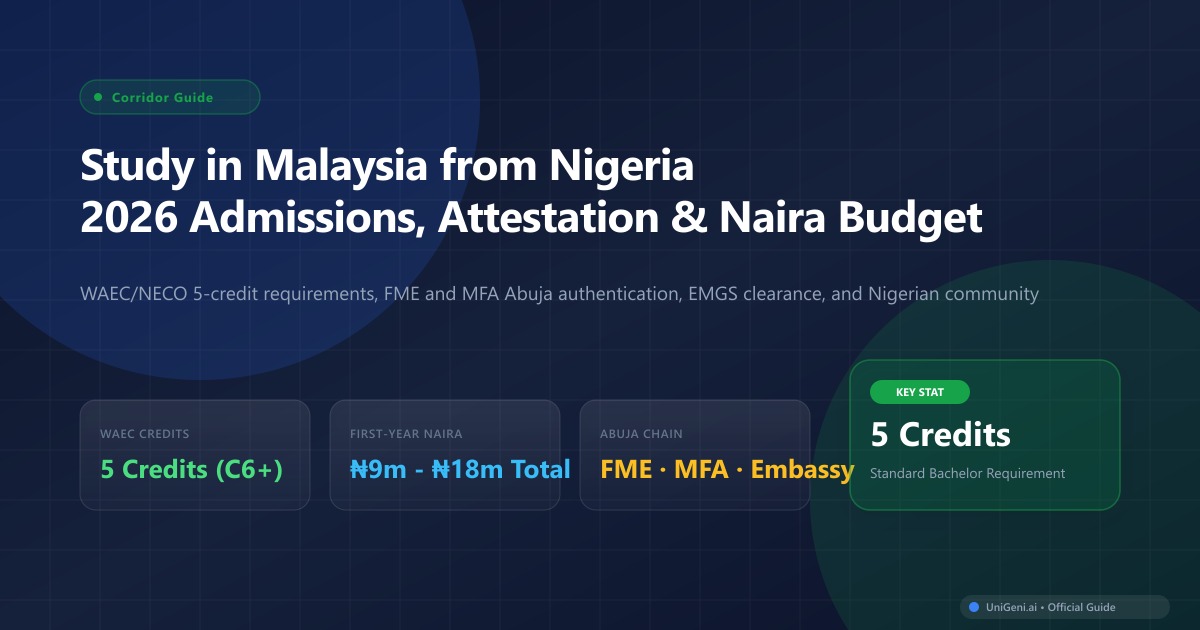
A Nigeria to Malaysia roadmap for 2026: WAEC entry rules, attestation, proof of funds, EMGS visa steps, flights and a realistic budget in naira.
Studying in Malaysia from Nigeria means planning one connected journey: your WAEC results and naira-denominated family savings at one end, an EMGS-endorsed Student Pass and a Malaysian degree at the other. Malaysia is one of the few English-medium destinations a Nigerian family can fund without the stretching that the UK or the United States now demands. Tuition at most private universities runs RM 20,000 to RM 40,000 a year, roughly 6.6 to 13.2 million naira at the September 2026 rate of about 328 naira to the ringgit, and student living costs add RM 1,500 to RM 2,500 a month. Nigeria sits among Malaysia's top ten source countries for international student applications, according to EMGS-based industry reporting, so the corridor is established.
Run in the right order, the whole process takes four to six months. Applications and offers take one to two months. The EMGS Student Pass stage usually runs six to ten weeks. The single entry visa from the Malaysian High Commission in Abuja adds one to three weeks, plus flight time. The three mistakes that most often derail Nigerian files are attestation done in the wrong sequence, bank statements that do not match the sponsor named in the application, and starting too close to the intake date. This guide walks the route in the order you will actually work through it. For the broad destination picture, start with the study in Malaysia hub, and use our cost of studying in Malaysia 2026 guide for the full budget build.
What this guide covers
- Checking Malaysia against your budget and qualification
- Mapping WAEC and Nigerian degree qualifications to Malaysian entry requirements
- Attesting documents through the Federal Ministry of Education and Foreign Affairs
- Preparing proof of funds that survives scrutiny
- Moving through the EMGS stage and the Abuja single entry visa
- Planning flights, arrival money and the community you land into
Why Malaysia works for Nigerian students
Three reasons come up consistently. Cost is the first: a full Malaysian degree commonly lands between US$25,000 and US$40,000 all-in over three years, a fraction of what one year alone costs in the UK or the US. The second is language: international programmes are taught in English, and Nigerian students arrive already fluent. The third is the community: Nigerians have historically been the largest African student group in Malaysia, so senior students, faith communities and familiar food networks already exist around the main campuses.
What WAEC gets you: entry requirements and equivalences
The West African Examinations Council certificate, WAEC or WASSCE, is generally treated by Malaysian universities as equivalent to O Levels and the Malaysian SPM. That matters because SPM-equivalent qualifications are the standard entry ticket to foundation and diploma programmes, not always to direct bachelor entry. You have three routes.
- Foundation first. A one-year foundation programme after WAEC is the most common route. Universities typically ask for five to six credit passes, including English and Mathematics, with science subjects relevant to your intended degree. Foundation tuition at private universities runs RM 16,000 to RM 28,000 in total.
- Diploma first. A two- to three-year diploma after WAEC leads into year two of a related degree at many institutions, suiting staggered financial commitments.
- Direct bachelor entry. Some universities admit strong WAEC results directly into three-year bachelor programmes; others require A Levels, an International Baccalaureate or a completed diploma. Treat the university's own entry page as the deciding source.
For a master's, a recognised Nigerian bachelor's degree is the baseline. Universities set their own grade floors, commonly around a second class lower or a CGPA of 2.5 and above, with four-year degrees widely accepted.
Attesting your documents: Federal Ministry of Education first
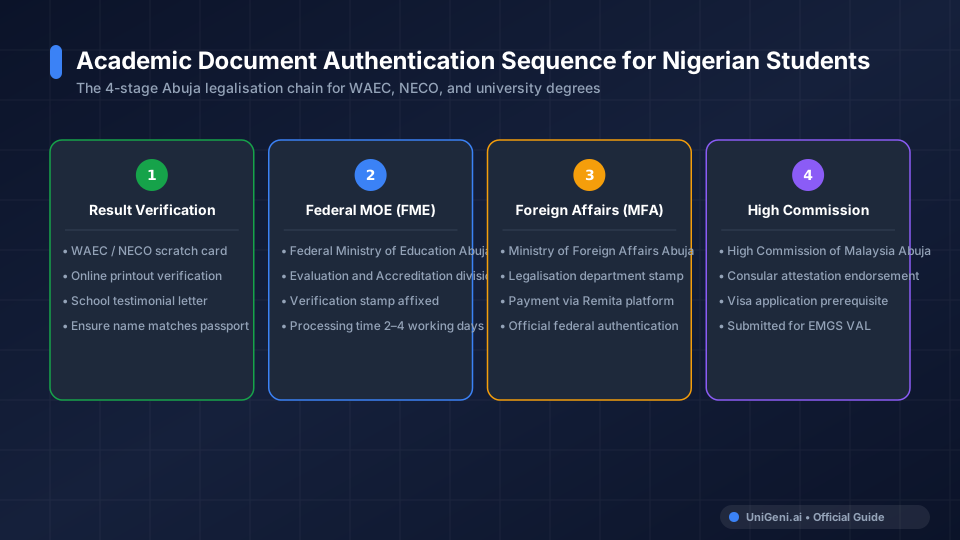
Malaysian universities and EMGS need to verify that your certificates are genuine, and Nigeria has a fixed sequence for this. The Federal Ministry of Education authenticates academic documents first, through its Evaluation and Accreditation System portal at essverify.education.gov.ng. The process is fully online: create an account, pay through Remita, upload scanned certificates, and for transcripts arrange for your institution to send the record directly. Published guidance indicates turnaround of a few working days for a complete file, though institutional email responses can add time.
Two rules save trouble. Order matters: education ministry authentication comes before any Ministry of Foreign Affairs step, and skipping ahead is the classic way files stall. And check what your university actually asks for: many private universities accept certified true copies for the admission decision and only need ministry authentication at the visa stage, so confirm before paying for services you may not need yet.
Proof of funds and sponsors
Malaysian universities and EMGS want evidence that tuition and living costs are covered. The working standard is bank statements covering roughly the last three months, in your name or your sponsor's. If a parent or guardian funds you, most universities accept a sponsorship letter with a copy of their identification and statements showing consistent balances. Guidance commonly cited for Malaysia points to US$7,000 to US$10,000 as a comfortable figure. That is not a published EMGS minimum. Each university sets its own expectation. The practical rules are consistency and traceability: the sponsor named in your application should match the account holder, sudden large deposits invite questions, and naira accounts are acceptable if the statement shows clearly convertible balances.
The EMGS stage and visa notes for Nigerian applicants
Once you accept an offer, your university files the Student Pass application with Education Malaysia Global Services on your behalf. The official EMGS client charter is 14 working days for a complete application, and the realistic pattern is four to six weeks, longer in peak intake months. The stage-by-stage walkthrough lives in our Malaysia student visa EMGS guide; the points below are the ones specific to Nigerian applicants.
- Single entry visa required. Nigeria is on Malaysia's visa-required list for students, so once your electronic Visa Approval Letter, known as the eVAL, is issued you apply for a Single Entry Visa at the Malaysian High Commission in Abuja before you travel. Nigeria is not on the faster eVISA channel some Asian nationalities use, so build the embassy stage into your timeline.
- Medical screening. The compulsory screening for new students happens at an EMGS panel clinic within 7 working days of arrival. General pre-departure medicals were removed in 2019, but EMGS has reintroduced home-country screening for selected nationalities; if Nigeria is added to that list your university will instruct you, so verify current rules for your intake.
- Timelines reward early files. Nothing about the Nigerian route is officially slower, but combined stages mean holding your complete file at least four months before your intake.
Flights and arrival
There are no direct flights from Lagos or Abuja to Kuala Lumpur, so you connect through hubs such as Doha, Addis Ababa or Amsterdam on Ethiopian, Qatar Airways or KLM. Indicative September 2026 fares start around US$741 one way and US$989 return, roughly 985,000 to 1.3 million naira, with January the cheapest month to fly and December the most expensive. Book only after your visa is stamped. Arrive with some ringgit in cash, your originals in your hand luggage, and scanned copies in cloud storage. The arrival fortnight involves showing the same papers repeatedly.
A realistic first-year budget in naira
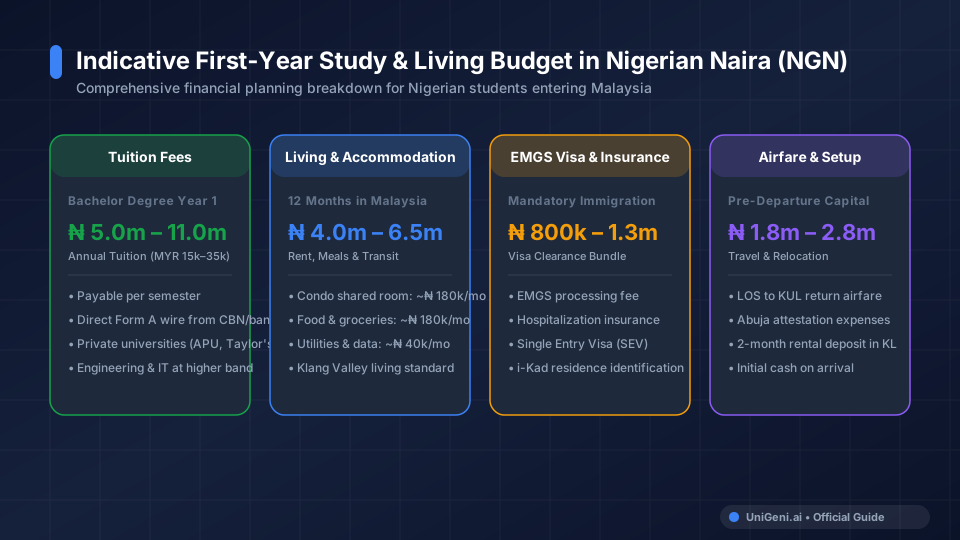
With every figure indicative, a first year at a mid-priced private university looks like this.
- Tuition: RM 20,000 to RM 40,000, about 6.6 to 13.2 million naira, with foundation years often cheaper
- Living costs: RM 1,500 to RM 2,500 a month, about 500,000 to 820,000 naira
- First-year EMGS and immigration charges: RM 3,200 to RM 4,950, about 1.05 to 1.6 million naira
- One-way flight: from roughly 985,000 naira
Naira figures move with the exchange rate, so recompute before committing. Merit tuition discounts are common, and our cost guide carries the city-by-city breakdown.
The Nigerian community in Malaysia
Nigerians have been described in academic studies as the largest African student group in Malaysia, concentrated in Klang Valley universities and postgraduate cohorts. That translates into Nigerian and African student associations at the larger campuses, churches and mosques within reach of the main student cities, and access to familiar staples. Halal food is the national default, and the adjustment challenge most often reported is financial discipline rather than culture shock: naira volatility makes budgeting the skill that decides how the degree goes.
Questions Nigerian applicants ask
Can WAEC alone get me into a degree programme? Sometimes. Some universities admit strong WAEC results directly into bachelor programmes; others require a foundation or diploma first because WAEC maps to SPM, the pre-university standard in Malaysia. Check each university's entry table.
Do I need IELTS if I have a WAEC English credit? Many universities accept a strong WAEC English credit as English evidence; others ask for IELTS or TOEFL regardless. This is a per-university decision, so confirm with admissions before paying for a test.
How much should be in the sponsor's account? There is no published minimum. The commonly cited planning figure is US$7,000 to US$10,000, and what matters more is a consistent account history matching the named sponsor.
Can I work while studying? International students may work up to 20 hours per week, but only during semester breaks longer than seven days and only in restricted sectors, with university approval. Build your budget without this income.
If you want your shortlist, attestation sequence and visa timeline mapped by someone who handles this corridor regularly, talk to a counsellor before paying for any service.
Sources
- Education Malaysia Global Services (https://visa.educationmalaysia.gov.my) — Student Pass process, client charter and Single Entry Visa mission list including Abuja for Nigeria.
- Federal Ministry of Education Nigeria (https://essverify.education.gov.ng) — ESS portal for academic document authentication and evaluation.
- Federal Ministry of Education Nigeria attestation page (https://education.gov.ng/attestation-of-academic-documents) — documents attestable and process overview.
- Central Bank of Nigeria (https://www.cbn.gov.ng) — official NFEM naira to dollar reference rates.
- StudyTravel Network (https://studytravel.network) — Nigeria among top ten source countries and 2024 application trend.
- Expedia (https://www.expedia.com) — indicative Lagos to Kuala Lumpur fares.