
Student Accommodation in Malaysia: Rents, Deposits and How to Choose
On-campus, off-campus or homestay: realistic monthly rents by city, deposit rules, utilities and scam red flags for students in Malaysia.
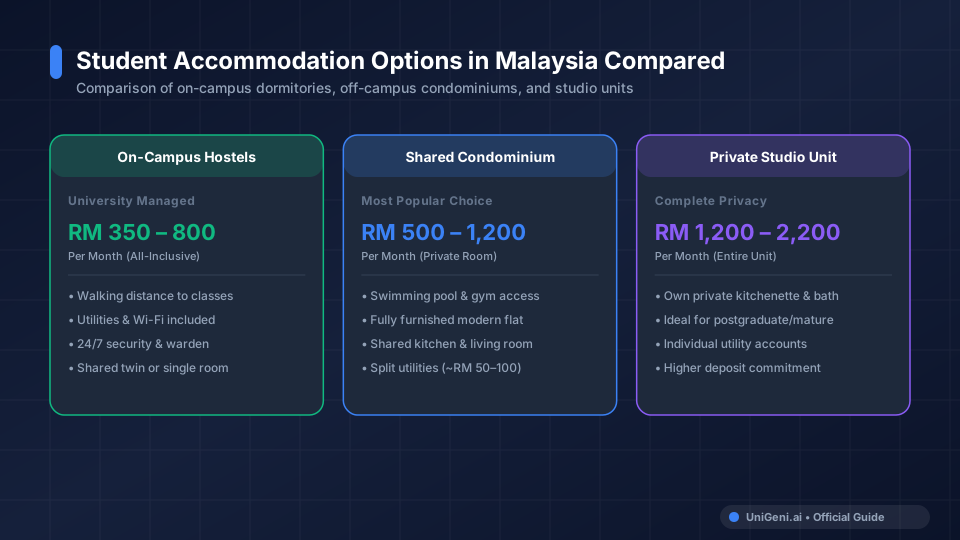
Student accommodation in Malaysia splits into three choices: on-campus hostels, off-campus rooms and apartments, and short-term options such as homestays and monthly hostel stays used while you hunt in person. Budget-wise, a student room in Malaysia runs from roughly RM 300 a month at the cheapest public university hostels to RM 1,800 for a private single room in central Kuala Lumpur. Most students land between RM 500 and RM 1,000. On top of rent, plan one to three months of rent as upfront deposits plus a utilities and internet share of roughly RM 100 to RM 200 a month.
This guide is for new international students choosing where to live and how much to budget, and for parents who want to know what is safe to pay before their child lands. It covers the trade-offs between the three housing types, realistic rents across Kuala Lumpur, Penang, Johor and Sarawak, how deposits and contracts work, what utilities cost, and the scam patterns that target foreign students booking from abroad. For the full picture of tuition plus living costs, see the cost of studying in Malaysia 2026 breakdown, and for arrival timing, our Malaysia intakes and deadlines guide. The wider country context lives on the study in Malaysia hub.
On-campus, off-campus or homestay
On-campus hostels
Campus hostels are the cheapest and simplest first move. Universiti Teknologi Malaysia in Johor Bahru publishes hostel rates of RM 300 to RM 600 per month and campus housing at RM 480 to RM 1,100 per month. Swinburne University of Technology Sarawak in Kuching charges by the week, from about RM 95 weekly for a twin fan room to about RM 250 weekly for a single air-conditioned room. You pay the university directly, contracts are tied to semesters, and there is no agent in the middle. The trade-offs are fixed meal times or canteen food, curfews at some institutions, and less privacy.
Off-campus rooms and apartments
Renting a room in a shared apartment is the most common setup after first year. You choose your area, cook your own food and split bills with housemates. Costs run higher than hostels, especially in Kuala Lumpur, and you handle deposits and contracts yourself. For students at private universities in KL, Cyberjaya, Selangor and Penang, this is where most of the RM 500 to RM 1,500 monthly band lives.
Homestays and short-term stays
A homestay or monthly-rate hostel is a landing pad rather than a home. Many students book four to eight weeks of temporary shelter, arrive, view real rooms in person, and move properly. It costs more per night but removes the biggest risk in this market, which is paying a deposit on a room you have never seen.
What rent really costs, city by city
City selection moves your budget more than almost any other choice.
- Kuala Lumpur. Student dormitories run RM 600 to RM 1,500 a month, a shared room RM 500 to RM 1,000, and a single room RM 800 to RM 1,800. Near Monash and Sunway in the Sunway and Subang area, and near HELP in Bangsar, mid-range condo rooms cluster around RM 650 to RM 900.
- Cyberjaya, next to Multimedia University. Rooms start from around RM 250, with purpose-built student suites around RM 750 for a twin room and RM 1,500 for a single. It is noticeably cheaper than central KL.
- Penang, around George Town and USM. Shared apartments are listed from around RM 700 a month for the whole unit, so per-room costs commonly sit near RM 350 to RM 700. Budget rooms across Malaysia broadly run RM 300 to RM 800.
- Johor Bahru, near UTM. On-campus hostels RM 300 to RM 600 a month, campus housing RM 480 to RM 1,100, with off-campus rooms in the city generally below KL prices.
- Kuching, Sarawak. The cheapest of the set. Swinburne's on-campus weekly rates convert to roughly RM 400 to RM 1,000 a month, and off-campus rooms in Kuching price below peninsular capitals.
Treat these as planning bands, not quotes. Rents move with currency, building age and how close you are to the campus gate, and listings sites such as iBilik, Speedhome and uhomes show the live market for any area.
Deposits and contract terms
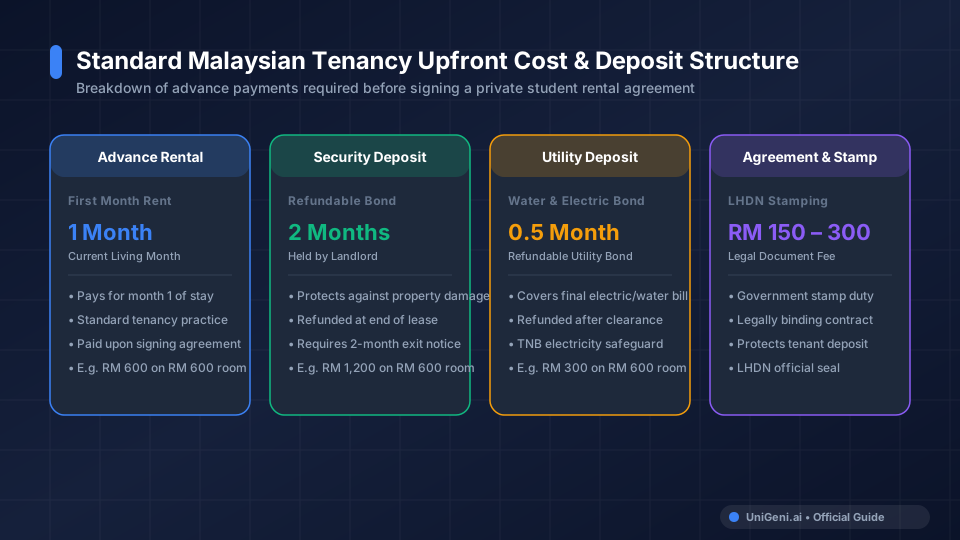
For a whole apartment, Malaysia runs on what agents call a "2 + 1 + half" formula: two months of rent as security deposit, one month paid in advance, and half a month as a utilities deposit. On a RM 1,200 apartment that means about RM 4,200 due before you move in, plus the tenancy agreement cost, usually RM 150 to RM 300 shared between landlord and tenant. Whole-unit agreements normally run 12 months, and breaking them early usually costs the security deposit.
For a single room, the market is lighter: typically one month deposit plus one month advance, sometimes with a smaller utility deposit, and contract terms that often follow semesters rather than a strict year. Get the agreement stamped and keep every receipt, because your deposit refund at the end depends on paperwork, not goodwill.
Utilities and internet
Electricity in Peninsular Malaysia is billed in blocks under the TNB domestic tariff effective 1 July 2025. The first 200 kWh a month cost 21.8 sen per kWh, the next block 33.4 sen, and the block above that 51.6 sen. A shared student apartment with modest air-conditioning use commonly lands at RM 80 to RM 250 a month per unit, split between housemates. Water is cheap, often RM 10 to RM 40 a month per unit. For internet, Unifi's 100 Mbps home plans run from roughly RM 90 to RM 145 a month depending on the bundle, again split across housemates. Many room rentals include a shared WiFi connection in the rent.
Watch for sub-metering. Some landlords resell electricity to room tenants at a fixed rate per kWh above the TNB rate, which is common but should be stated in the agreement before you pay anything.
Before you pay anything: scam checks
Foreign students booking from Pakistan, Bangladesh, Nigeria and the Gulf are prime targets for rental scams. Run through this list before money leaves your account.
- A price far below the market for that area, paired with urgency, is the classic hook.
- No video walkthrough, no live tour, and refusal to show the actual room.
- Pressure to pay a deposit immediately to "hold" the room, especially to a personal bank account that does not match the landlord's name.
- No tenancy agreement, or an agreement that arrives only after payment.
- An "agent" who cannot show the property and communicates only through WhatsApp with no office or verifiable listing.
- Requests for your passport copy and full deposit before any offer letter or visa stage, which scams sometimes use to look official.
Safe habits are boring but effective: book university hostels through the university portal, use established platforms with reviewed listings, pay only against a signed agreement, and keep the payment traceable. If a deal cannot survive a video call and a written agreement, it is not a discount, it is a trap.
Booking remotely or arriving early
Booking remotely from abroad saves your first weeks of hotel costs and secures a bed on day one. It is reasonable for on-campus hostels booked through the university itself, where your payment goes to an institution rather than a stranger. For private off-campus rooms, the safest pattern is a short-term booking for two to eight weeks, arriving ahead of orientation, and choosing your long-term room after seeing it. Students who combine both, campus hostel for semester one, private room from semester two, get a soft landing and a smarter second choice.
Frequently asked questions
Is on-campus housing guaranteed for international students?
At many public universities, first-year international students get priority, but it is guaranteed only if you apply before the hostel deadline, not merely by being admitted. At private universities, on-campus blocks are limited and fill fast for the September intake. Apply for housing the day you accept your offer.
How much cash should I have for housing on day one?
For a room, count roughly three months of rent in total: one month deposit, one month advance and a buffer for utilities. For a whole apartment, count about 3.5 months of rent plus the agreement fee. Then add your first utility top-ups.
Can I get my deposit back if I leave early?
For whole units with a 12 month agreement, usually not, unless the landlord agrees to a replacement tenant. Room agreements on semester terms are more flexible. Read the refund clause before signing, not after.
Which city is cheapest for student housing?
Of the major student cities, Kuching and Johor Bahru are cheapest, Cyberjaya and Penang sit mid-range, and central Kuala Lumpur is the most expensive, with the Sunway and Subang corridor close behind.
If you want your housing shortlist sanity-checked against your campus and budget, talk to a counsellor and we will review options before you send money anywhere.